


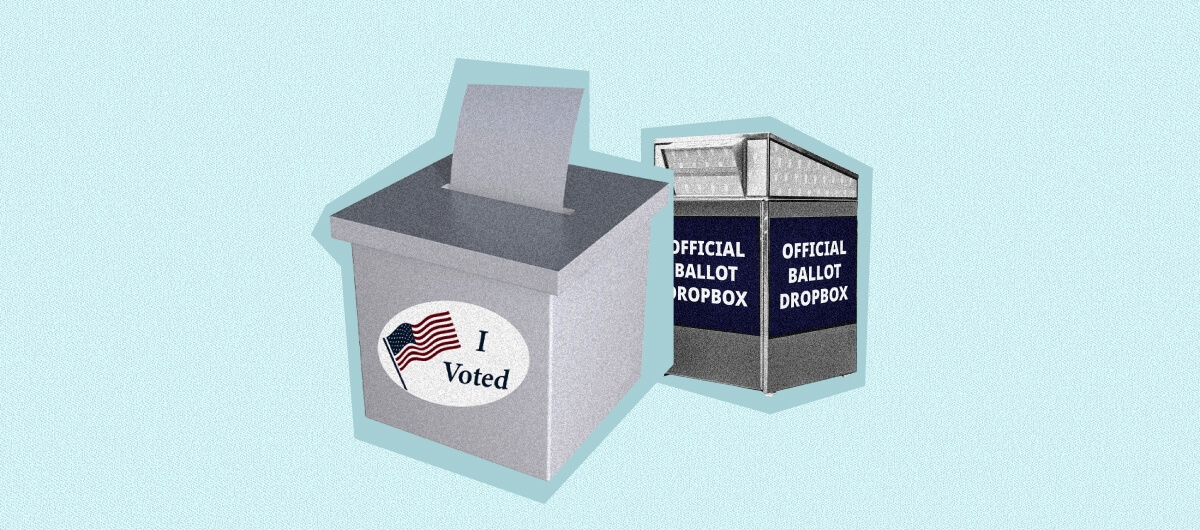
From federal interference in elections to a Supreme Court that has weakened voting rights protections, the threats to American democracy are interconnected—so are the reforms needed to confront them.
This article was made possible because of the generous support of DAME members. We urgently need your help to keep publishing. Please join us for as little as $1.00 a month or make a one-time gift in any amount!
If we’ve learned nothing else from the last 20 years, it’s that our duty to democracy and each other doesn’t begin or end with electoral participation and voting. The current political landscape presents several challenges, including an open and notorious attack on democracy led by an extremist federal government. With voting in the 2026 election already underway, communities and election officials nationwide face an unprecedented threat to our democracy’s future.
The Trump-Vance administration has weaponized claims of virtually nonexistent voter fraud, particularly non-citizen voting, in an attempt to disenfranchise voters and dictate election outcomes. Relying on dubious claims and flawed technology, the administration continues to pressure states to aid efforts that could potentially disenfranchise lawfully registered voters.
As California Secretary of State Shirley Webber outlined in a letter to the Department of Justice, declaring thousands of voters “ineligible until proven otherwise” violates federal law. Under the National Voter Registration Act, voters cannot be removed from eligibility within the 90-day “quiet period” before an election.
“Nowhere has the federal government clarified the basis for suspecting—not even confirming with any level of certainty—the listed individuals are non-citizens,” she wrote. “California’s election administration will continue to be governed by applicable federal and state law, not by unsubstantiated claims and outrageous demands.”
The act of aggression against California’s election administration follows a recent report from Democracy Forward exposing the full breadth of the Trump-Vance administration’s attack on American democracy. Based on a review of over 13,000 pages, the report outlined the administration’s extreme efforts under the guise of rooting out virtually non-existent voter fraud.
“This trove of ICE documents provides chilling new insights into the breadth and depth of the Trump-Vance administration’s efforts to pursue baseless claims of widespread election fraud and assert greater federal control over elections ahead of the 2026 midterms,” said Hart Wood, Senior Oversight Counsel at Democracy Forward. “These records also expose the influence of election denier Heather Honey at both DHS and ICE – including her working in partnership with activists and feeding nearly 50 million records from ‘independent sources’ into DHS voter fraud data collection. They also show, for the first time, that HSI [Homeland Security Investigations] may be using undercover agents to investigate non-profits for purely political reasons.”
From treating elections as sports contests between rival teams to breaking up with our ill-informed nostalgia, this moment, and this election, is a serious wake-up call. Rebuilding and restoring American democracy, and the fundamental right to vote, must start with this baseline understanding of what ballot access actually means. Meeting the challenge ahead requires a shift in how we understand the right to vote as a voice in how our government is run and in the issues and conditions that affect our lives.
Regrounding Voting Rights in Political Empowerment
The Trump administration’s efforts build on the decades-long project of undermining and undoing the protections afforded by the Voting Rights Act of 1965 (VRA). More than 30 years ago, the late civil rights scholar and attorney Lani Guinier outlined a path to a stronger, more representative democracy in her 1994 book, “The Tyranny of the Majority: Fundamental Fairness in Representative Democracy.” Guinier asserted that the VRA was a tool of political empowerment. In her analysis, voting rights weren’t limited to casting a ballot or electoral control. At its core, it’s about “the right to meaningful participation and to an effective voice in government.”
Guinier further expanded on the need for an affirmative right to vote in a 2009 New York Times op-ed, where she framed voting rights as the only fundamental right dependent on the political whims of those in power.
“Relying on the 15th Amendment alone, however, is not enough to guarantee all Americans the constitutional right to vote,” she wrote. “Unlike the First Amendment which guarantees the right to free speech, the 15th Amendment, like the 19th Amendment, protects citizens only in the negative: a state cannot deny or abridge the right to vote on the basis of race or sex.”
Commenting on the Court’s decision Northwest Austin Municipal Utility District v. Mukasey (2009), Guinier warned that despite upholding the VRA’s preclearance requirement, Chief Justice John Roberts remained committed to upholding states’ rights over individual rights. A warning that would bear fruit in the devastating Shelby County v. Holder (2013) decision just four years later.
Constitutional litigator and voting rights expert David F. Walbert has echoed Guinier’s sentiment about the Court in his latest book, “Stealing Elections, American Style”. In a chapter on voter suppression, Walbert called Shelby an “ultra-radical” decision that undid a major enforcement mechanism of the Voting Rights Act.
“Theoretically, Shelby left open the possibility that the coverage formula could be revised by Congress and Section 5 could once again take effect,” Walbert wrote. “The formula rationale Roberts trotted out was just a ruse to mask how extreme the decision was and to deflect criticism from the Court to Congress.”
Safeguarding an effective voice in government also requires setting aside the former days of passive participation and blissful ignorance. In an interview with DAME, David Daley, author of “Antidemocratic: Inside the Far Right’s 50-Year Plot to Control American Elections”, called the road forward a “really long and difficult path.” But he said the moment required a grounding in the reality of the political era.
“We’re not discussing these issues with the urgency and the purpose with which we need to,” Daley said. “And so much of that is because of the current way in which we talk about politics and run campaigns and learn about what’s happening is not up to meeting the moment and this challenge.”
Voting Rights Reform Requires an Integrated Approach
Similar to the fight to get big money out of our politics, restoring strong, affirmative voting rights protections requires a suite of tactics and reforms. Civil rights and pro-democracy groups have long called for the passage of the John Lewis Voting Rights Advancement Act, which would restore and update protections under the Voting Rights Act, namely Section 5 pre-clearance. Often seen as companion legislation, the Freedom to Vote Act addresses anti-democracy measures and partisan gerrymandering while also protecting poll workers and election officials.
But for Daley, restoring democracy, free and fair elections, and voting rights cannot truly move forward with the Supreme Court’s current makeup. “While all of these problems are deeply interconnected, so many of them begin with the U.S. Supreme Court,” he said. “Whether you’re talking about trying to fix money in politics, extreme gerrymandering, voter ID purges, runaway misrepresentation, and resegregation of voters, especially across the South, in a supermajority that put all of these forces into motion.”
Shedding our nostalgic view of the Court as a neutral institution and great equalizer helps advance reform. As I think about the path forward and how to deal with the Court, I keep replaying a simple quote from award-winning civil rights and human rights attorney Jaribu Hill: “The Warren years are over.”
From 1953 to 1969, Chief Justice Earl Warren led the Court through a period of progressive decisions including Brown v. Board of Education. (1954) and Baker v. Carr (1962), which established the legal principle of “one person, one vote.” The Warren Court upheld the VRA against early challenges. Although it lasted only 16 years, the Warren Court left an imprint on the American psyche about the Court’s role. As founder of the Mississippi Worker’s Center for Human Rights, Hill has spent 30 years deep in the struggle for human dignity and freedom. Her simple comment served as a jarring reminder that much of what we think of as the Court’s role as a neutral arbiter of justice stems from nostalgia for a brief moment in history.
The end of the Warren Court marked the beginning of a conservative shift that expanded its grip over the last 50 years. Now, under Roberts, the Court has shown it will not protect us from efforts to dilute our votes and undermine our rights. In some instances, like Louisiana v. Callais, it has even aided and abetted anti-democracy efforts.
“It would be recklessly naive of us to believe that these problems could be resolved through legislation alone,” Daley said. “That legislation will simply wind up back at the same Court.”
While many Court reform advocates have called for expanding the number of justices on the bench, the Brennan Center outlined six steps to fix the Supreme Court. At the core of the recommendations is a focus on “protecting democratic institutions, upholding the rule of law, and safeguarding individual rights.” Recommendations include instituting 18-year term limits, curbing the Court’s abuse of the shadow docket, strengthening ethical standards, and improving the confirmation process.
Beyond Court reform, restructuring the federal regulatory apparatus and restoring independence to key agencies like the Department of Justice also help protect political participation for all. Consolidating power requires divesting from a winner-take-all system that incentivizes hostile power grabs. Strict adherence to institutional norms at a time of rising authoritarian crisis will not restore our rights.
State leadership on political participation and election administration could make a difference amid increasing federal interference. Groups like the Legal Defense Fund have supported advocates expanding ballot access state by state. In several states, legislatures have enacted their own versions of democracy reforms that enshrine voting rights and expand key protections. Five states took action to enact or expand voting rights this year alone, bringing the total to 11 states providing expanded coverage for full political participation.
Safeguarding Election Administration to Maximize Political Participation
Adopting full participation as the default standard also resets the way we approach election integrity. There shouldn’t be a trade-off between ensuring our votes and elections are secure and people’s ability to participate in the franchise.
Several states have improved voting access and resourced election administration. In Michigan, groups like All Voting is Local have carved out space to protect both election integrity and voter access. In August, All Voting is Local partnered with the Brennan Center, Campaign Legal Center, and Protect Democracy for guidance on election certification in several key states. The groups said there were “at least 17 attempts to interfere with certification of elections in 2024.”
Speaking with DAME, All Voting is Local’s Michigan State Director Ashiya Brown said Michigan ranks high in election security for a reason. “It’s about having safeguards in place,” she said. “Once you have safeguards in place for a system, then you just literally let the process do its justice.”
Some safeguards include bipartisan representation at polling sites and during vote counts, as well as the audit process. While some anti-democracy opponents have tried to undermine Michigan election outcomes with claims of virtually nonexistent fraud, Brown said the systems in place caught and addressed the few instances. She also stressed the importance of clear laws that support a smooth process to reduce errors and prevent things from being lost in translation.
“We’ve had really good, fair elections in this state for a long time,” she said. “The checks and balances that are in place on election night, before election, after election down to the certification process, are made in a very balanced way.”
For Brown, an election security expert by trade, the current administration tries to exploit a thin line between election integrity and voter suppression. Brown said that, contrary to the administration’s framing, we don’t need to sacrifice political participation for the sake of election safeguards. A system grounded in the right values can do both.
That work also includes resourcing and supporting local election staffers on the front lines of election administration. Funding cuts and the hyperpartisan attacks on election workers and federal entities like the Election Assistance Commission and the Cyber and Infrastructure Security Agency have left local election administrators struggling against emerging threats. Brown said resources that could help election officials close gaps or address things like AI-generated deepfakes no longer exist. “AI is a huge thing,” she said. “It just takes one to two videos and a little bit of traction on the right social media account to get people’s total distrust in elections.”
Restoring Voting Rights Requires Sustained Action
Five years ago, I wrote that voting alone can’t save democracy. As we’ve seen in recent years, it takes a robust network of civil society and grassroots organizers to sustain us.
Over the past year, we’ve watched the Trump administration attack big law firms that have done pro bono work, the entire media landscape, and civil society groups committed to fairness and equity. Democracy infrastructure also includes public media and restoring integrity to journalism, the so-called fourth estate. It’s not enough to point out the hypocrisy and corruption in this country’s intense consolidation of media power. We need to actually support outlets and entire ecosystems of information building that are focused on building a better understanding of the work ahead.
“We are still very much locked into sort of a red-versus-blue food fight in our elections and in our media,” Daley said. “And what we need to be doing with elections is using them to build support for an agenda and for real action.”
Part of building that support is having genuine conversations with people about the issues before us and why they matter. Vote-shaming and finger-wagging won’t move people to action.
Brown says having trusted messengers can make a world of difference when trying to connect to voters about their rights. She said it was important to make sure everyone from local election officials to partners have the right terms and messaging to reach people.
One example concerned documentary proof of citizenship and who it would actually affect. While a messaging guide or talking points might not seem like a radical intervention, it can make the difference for smaller organizations or volunteers trying to cut through the noise. With rising election spending and targeted disinformation campaigns, we need more people doing direct person-to-person outreach and engagement.
“Storytelling is something that we’ve been finding to be really, really helpful this past year,” Brown said. “Communicating often is important… making the messages as clear and as concise as they possibly can, and then relating them to the communities.”
The trusted messenger role is especially important as people worry about how and where to vote. Brown said there’s confusion around mail-in ballots, and people worry whether their votes will even count.
“We have to take into account that in the November elections, USPS causes a lot of confusion for a lot of people,” she said. “So trying to make sure they know that there are early voting sites, trying to also tell them, like, if you don’t trust it, just show up on Election Day, but just still getting people out to vote when there might be a method of voting that they no longer look to as being trustworthy.”
The work of building trust must extend beyond Election Day, and it requires sustained organizing and community engagement to shift the tide. Daley sees a narrow window for reform, but it will require advancing a pro-democracy agenda at the state and federal levels. Daley stressed the urgent need for reforms ahead of the 2030 Census and midterm elections. Anticipated population shifts could move at least a dozen seats to states currently led by anti-democracy majorities.
“Those seats move electoral votes,” Daley said. “So anyone who is looking to reform the system before more authoritarian-minded forces return to power and consolidate power has to do so quickly.”
Before you go, we hope you’ll consider supporting DAME’s journalism.
Today, just tiny number of corporations and billionaire owners are in control the news we watch and read. That influence shapes our culture and our understanding of the world. But at DAME, we serve as a counterbalance by doing things differently. We’re reader funded, which means our only agenda is to serve our readers. No ads, no both sides, no false equivalencies, no billionaire interests. Just our mission to publish the information and reporting that help you navigate the most complex issues we face.
But to keep publishing, stay independent and paywall-free for all, we urgently need more support. During our Spring Membership drive, we hope you’ll join the community helping to build a more equitable media landscape with a monthly membership for as little as just $1.00 per month or a one-time gift in any amount.