


Trumpism
What Trump’s Trade War Is Doing to America’s Farmers
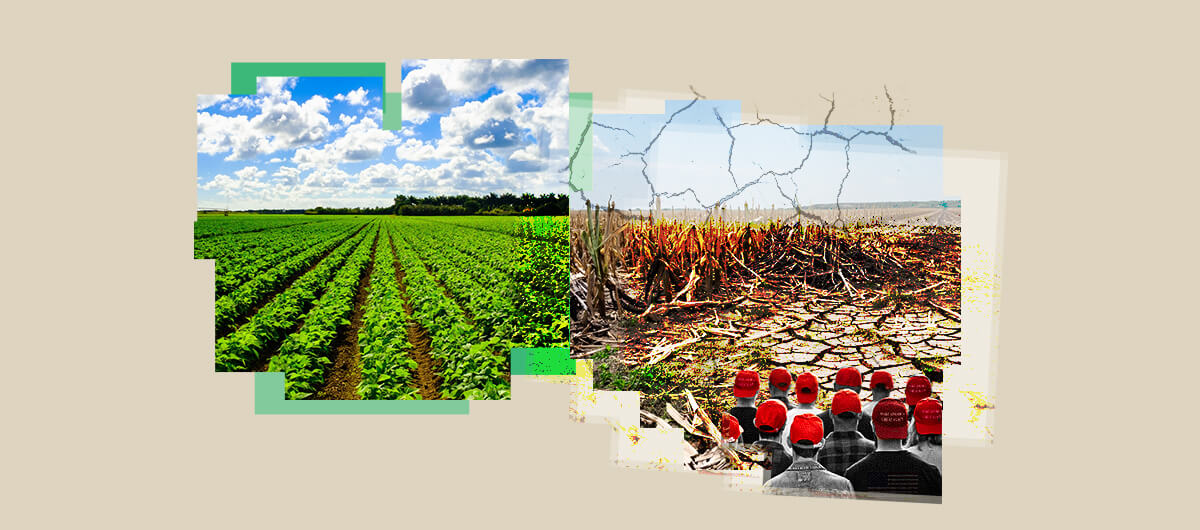
Trump promised to revive rural America. Instead, trade wars, soaring input costs, and industry consolidation are pushing family farms to the brink
This article was made possible because of the generous support of DAME members. We urgently need your help to keep publishing. Please join us for as little as $1.00 a month or make a one-time gift in any amount!
When then-presidential candidate Donald Trump made his closing pitch to voters in late October 2024, he singled out the millions of Americans living in rural communities for special attention. Backed by a record amount of agriculture industry spending, Trump painted a bleak picture of farmers under assault by Democratic regulations and immigration policies. Former President Joe Biden may have forgotten rural America, Trump argued, but Republicans were prepared to foster a new economic golden age for small farmers and their crumbling small towns.
That proved to be a smart strategy: 62 percent of rural Americans cast ballots for Trump, compared to just 36 percent for Kamala Harris. Trump performed about 4 percent better among rural communities in 2024 than he did in 2020. The numbers spoke to the deep faith rural voters had in the MAGA movement’s promises — and in Trump’s commitment to saving the nation’s agricultural heartland.
One year into his second term, the suicide rate among American farmers hit a record high amid a growing rural mental health crisis. Economic hardship and industry pressure has pushed the suicide rate among farmers to 3.5 times that of the general population. Instead of help from the federal government, rural communities have been met with silence.
The rural voters who propelled Trump back into the White House often fade into the background of stories that attempt to document the full depth and breadth of Trump’s economic mismanagement. So much has gone wrong so quickly across so many parts of our national economic life that it can feel like an exercise in futility to try and contextualize it all. That’s especially true in rural communities, where local newspapers shut down years ago and stories of financial hardship too often go untold amid a frantic scramble to survive.
America’s rural communities sprawl across the country like a chain of sparsely-populated islands separated by miles of country roads and interstate highways. Cairo is a small town near the southern tip of Illinois, just about three hours south of Champaign along Interstate 57. Cairo was already a fading town in 2020, when it was home to just 1,733 people. Today the town is nearly empty, the victim of a decaying industrial base and the consolidation of nearby farmland. It’s kept alive through the inertia of an aging population who can’t afford to move anywhere else.
Trump promised to save towns like Cairo. Instead, his tariff policies turned the town’s decline into a fatal tailspin. Cairo was one of the many towns across Illinois that contributed to the state’s over 4,000 manufacturing industry layoffs in March alone, in part thanks to tariffs of up to 46 percent on imported rubber used by the town’s few remaining fabrication plants. Many of Cairo’s few remaining residents think the town could be wiped off the map by the end of Trump’s presidency. Cairo’s story is one retold in blue states and red states, in farm towns and old manufacturing hubs, in every corner of the country. The story is largely the same every time: Those who can leave, do. Those who can’t? They die with the town.
Bitter Harvest
That story is especially bitter to the small town farmers who overwhelmingly supported Trump and his MAGA agenda in 2024, even after facing similar economic hardships during his first aborted trade war against China in 2019. No group in America has been hit as hard or as directly by Trump’s global trade war as farmers, and despite tens of billions of dollars in promised relief from the White House, few family farmers have actually seen that money materialize.
“I am more concerned now than I have been in my 30 years of farming,” small farmer Mark Mueller told NBC News earlier this month. “This is that perfect storm where everything comes together and hammers the farmer. Our government made our life more difficult by walking away from trade deals or instituting tariffs or just basically making our customers angry — our customers being other nations and companies in other nations.”
Mueller is a fourth-generation farmer and now fears he will be the last in his family to work the land. Tariffs and the spiraling war in Iran have combined to drive up oil and natural gas prices, both of which are essential for farming. Natural gas is a primary ingredient in commercial fertilizer, and even in normal times the cost of bulk fertilizer purchases eats into a small farmer’s thin profit margin. Trump’s twin economic crises are pushing costs to an unsustainable level.
In the past month, Mueller has seen his fertilizer costs rise from around $795 per ton to nearly $1,000. He’s also paying nearly double the price per gallon for diesel fuel. Since Mueller and other farmers can’t raise the price they demand for their crops, they are forced to eat those rising costs in the form of sweeping annual losses.
That’s assuming American farmers can even sell their products at all; Trump’s tariffs have reduced global demand for U.S.-grown crops to the point that farmers can’t even sell what they already have. Chinese agricultural imports have plummeted by nearly 80 percent from their peak of $38 billion. Last year Chinese buyers imported only about $8 billion worth of soybeans and other crops, with devastating results for small farmers who were already barely holding on.
“It’s pretty obvious here what’s driven a decline in exports over the last couple of years, and that is one market — China — which was by far the leading buyer of U.S. agricultural exports, and that has been on a downward trend with trade tensions in 2025,” University of Tennessee agricultural policy chair Andrew Muhammad told FarmProgress.
Soybean farming, which now accounts for about 14 percent of total U.S. crop exports, has become one of rural America’s few growth sectors. China’s decision to abandon American soybeans in favor of Brazilian farmers blew a nearly $10 billion hole in small-farm revenues. That hasn’t gone unnoticed by normally GOP-sympathetic industry trade groups. The American Soybean Association publicly criticized Treasury Secretary Scott Bessent for misleading farmers on potential future Chinese soybean purchases after China spent an unprecedented five months refusing to buy even a single American soybean. It was the first time in memory that a major agriculture trade group had openly slammed a Republican president for failing American farmers.
Meanwhile, small farm operations are expected to do more with less. Steel and agricultural parts were specifically targeted by Trump’s broad tariffs, meaning it’s even more challenging for family farm operations to access the materials needed to repair aging machinery. That’s a particularly bitter pill for many small farmers to swallow after Trump pledged to lower the cost of farm equipment back in December. Instead, prices went up on nearly every type of machinery.
In some cases imported spare parts are not available at all, forcing farmers to take out costly loans for new equipment that is also skyrocketing in price due to inflationary pressure. The average price of a new tractor was roughly $190,000 in 2019. Today, a new tractor retails for about $330,000. The increased per-acre cost of running that tractor puts some small farmers in the paradoxical position of making less money the more they farm.
A Farmer Bailout (For the Rich)
Trump seems to know he has a major problem on his hands, because those frustrated farmers are critical if Republicans want to hold on to the House and Senate this November. But addressing the rising costs for farm communities would mean backtracking on his tariff policies. On the other hand, failing to do anything would likely lead to millions of rural voters staying home on Election Day. Both outcomes would be public humiliations for a GOP that built its electoral majority on a pledge to protect farmers.
“The question is not, ‘Are they going to suddenly flip to Democrat?’” Brian Reisinger, a Republican strategist and rural policy expert told Politico last month. “The question is, ‘Are they going to be as motivated… now as they were in 2016 or in 2024?’”
That’s a real risk. Purdue University’s farmer sentiment barometer tracks the public mood across the agriculture industry, and each month’s report brings new headaches for policymakers. Farmer sentiment is now at its lowest level in nearly two years, and over 40 percent of farmers say they are worse off today than they were a year ago. They’re also increasingly likely to blame Trump — not Democrats — for their problems.
Facing a potential revolt among his rural base, Trump hurriedly announced what he called a “$12 billion farmer bailout” in December 2025. That aid package would be paid for, Trump boasted, with tariff revenue collected from the very farmers he was now partially paying back. As small farmers would soon discover, Trump’s marquee bailout initiative wasn’t quite what it seemed on the surface. Despite explicitly promising the bailout to cash-strapped small farmers, more than half of all federal aid went to industrial farmers and giant agribusiness firms that were also major Trump campaign donors. Family farms were left to pick up what few scraps remained. The Environmental Working Group, an agricultural nonprofit, estimated that the bottom 80 percent of American farmers — almost all small holders and multi-generational family farmers — were paid less than $5,000 each in federal aid while agribusiness companies pocketed checks averaging about $180,000.
Farmers will tell you this kind of corporate handout is nothing new for Trump. Of the over $40 billion in agricultural subsidies Trump authorized in 2025, over 60 percent went to the country’s agribusiness giants. Those Big Ag companies are now among the only profitable agriculture operations in the country, and they are pouring excess cash into buying up failing family farms for pennies on the dollar. Facing mounting debts and dwindling foreign markets, many small farmers ultimately make the painful decision to sell.
Big Agriculture’s Vulture Capitalism
Trump’s tanking economy has offered a ripe playing field for the fattened wallets of vulture capitalist agribusinesses. Small-farm bankruptcies surged 46 percent in 2025, according to data compiled by the American Farm Bureau Federation. Red states in the Southeast and Midwest racked up an eye-popping 70 percent farm bankruptcy rate — the highest level since 2019-2020, the last time Trump was president. In Georgia alone, farm failures were up over 145 percent from 2024.
As distressed farms are sold at fire-sale prices to corporate conglomerates, America’s farmers are being displaced by Wall Street investors. Tech start-ups like AcreTrader offer the chance for investors to buy distressed farmland as part of a broader financial portfolio, with the property itself often leased out to giant agriculture companies who actually work the land. The nation’s largest owner of farmland is now tech titan Bill Gates, who owns over 270,000 acres of prime productive land. Critics rightly describe the shift from farmer-owned to investor-owned rural land as one of the biggest transfers of wealth in American history.
AcreTrader also boasts a prominent early investor: Vice President JD Vance. It’s just coincidental, then, that Trump’s $12 billion bailout has spurred a farmland buying spree mediated by companies like AcreTrader. The opportunities for private purchases of distressed farmland are surging at the same time as the United States Department of Agriculture (USDA) is laying off tens of thousands of civil servants tasked with helping small farmers keep their land in family hands. Republicans would like you to believe that’s just an unfortunate coincidence.
It’s one of the great ironies of American farming that actual farmers are facing bankruptcy while in 2025 the cash value of farmland hit an all-time high of over $15,000 per acre in some parts of the country. Most family farms are now discovering that they are too small to be profitable, but the land around them is too expensive to buy. Enter the agribusinesses, flush with Trump’s $12 billion bailout and eager to buy land from anyone willing to sell. Given how dire the financial situation has become for most small operations, that’s almost everyone.
“The big [farms] are definitely getting bigger,” Purdue agricultural economist Todd Kuethe told FarmProgress in February. More importantly, many of those megafarms are behaving less like productive agriculture operations and more like elaborate land investment schemes designed to suck up federal tax breaks for their corporate owners and shareholders. America’s rural heartland increasingly has no need for the farmers who once made it the most productive land in the world.
With the nation only months away from a pivotal midterm election, Trump and his Republican enablers must now reckon with the millions of rural Americans they’ve left behind. Far from protecting farmers and rural communities from the uncertainties of global markets, Trump has gutted American agriculture in a way none of his predecessors would ever have imagined possible.
Rural America’s economic recovery will take years — if such a recovery is even possible after the trade chaos inflicted by Trump’s tariff policies. As farmers saw in China’s decision to move its soybean purchases from Indiana and Kansas to Brazil, the world is already making contingency plans that exclude American markets entirely. Winning back those spurned foreign buyers isn’t a priority for a Trump administration too prideful to admit it was dangerously wrong.
Weary rural communities are bracing for the worst. USDA’s 2026 forecasts predict a decline in net farm income of nearly 3 percent, enough to drive hundreds more family farms into bankruptcy. What looked like a contraction in the agriculture sector a few years ago now seems like a crisis that will likely extend through Trump’s entire second term.
With farm debt estimated to increase 5 percent to over $624 billion this year and the value of U.S. export crops declining, the only realistic option for most farmers is to sell their land and try to escape the rural towns that are dying around them. They’ve given up expecting help from the president who boldly pledged just over a year ago to bring small farmers into a new golden age. America’s beleaguered farm communities now count their lives one day at a time, trapped in a fading hope that someone — anyone — is coming to save them.
Editor’s Note: This story has been updated to clarify Vice President JD Vance’s relationship to the platform AcreTrader.
Before you go, we hope you’ll consider supporting DAME’s journalism.
Today, just tiny number of corporations and billionaire owners are in control the news we watch and read. That influence shapes our culture and our understanding of the world. But at DAME, we serve as a counterbalance by doing things differently. We’re reader funded, which means our only agenda is to serve our readers. No ads, no both sides, no false equivalencies, no billionaire interests. Just our mission to publish the information and reporting that help you navigate the most complex issues we face.
But to keep publishing, stay independent and paywall-free for all, we urgently need more support. During our Spring Membership drive, we hope you’ll join the community helping to build a more equitable media landscape with a monthly membership for as little as just $1.00 per month or a one-time gift in any amount.