


Foreign Policy
America’s Long War on Iran Didn’t Start This Weekend
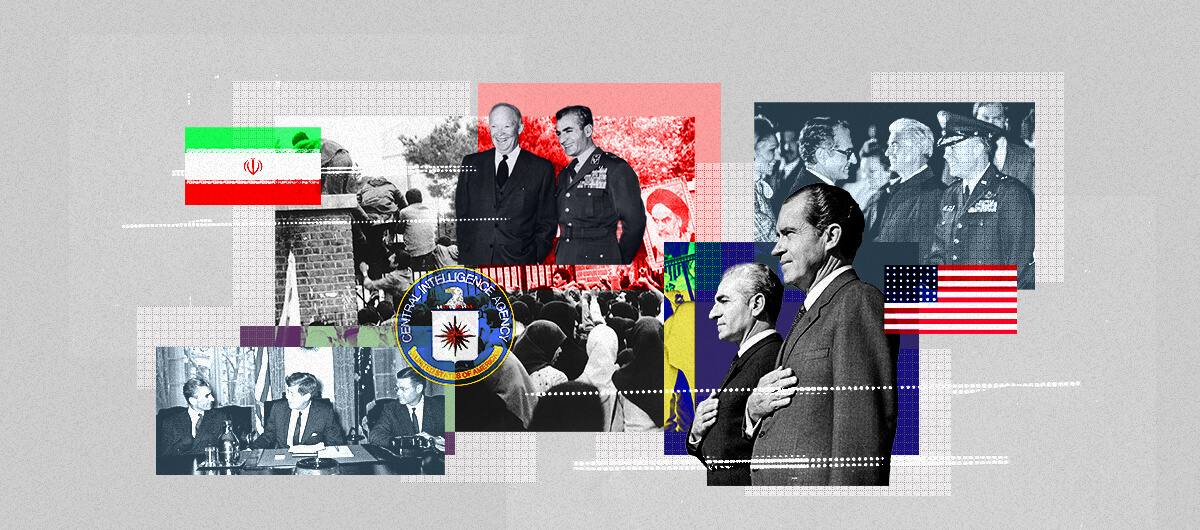
The United States has been trying to shape Iran since 1953. Every attempt has left the country more unstable and the two nations further apart.
This article was made possible because of the generous support of DAME members. We urgently need your help to keep publishing. Please join us for as little as $1.00 a month or make a one-time gift in any amount!
This weekend, the world awoke to discover that the United States and Israel had begun bombing Iran. It wasn’t exactly a surprise; U.S. troops have been mobilizing for weeks around the country. But what President Donald Trump and those around him want is much more unclear. Trump claims to want total regime change and promises that he can achieve this through military action alone. There’s no real plan: he expects that once Iranian leaders are dead, the people will come together and form a new government that he can deal with.
The U.S. has been meddling in Iran for more than 50 years now, each time to catastrophic effect. Those choices have no doubt shaped and influenced Trump’s military decisions, and those same choices have left many Iranians with an understandable fear of United States involvement. Now, as we bomb their country, we’re setting ourselves up to repeat history.
1953: The Coup That Set the Stage
Iran was a country that few Americans had any familiarity with before the 1950s. In 1908, it had been informally divided between the Russians and the British into different spheres of influence. The country had rich oil deposits; the Anglo-Persian Oil Company (a grandparent company of BP) was formed in 1909 and gave the British a strong commercial interest in the country while controlling most of its oil profits. In 1951, the country’s new prime minister, Mohammad Mosaddegh, sought to nationalize the oil industry and bring it under Iranian control. For the British, this was seen as an unacceptable loss of influence; for the Americans, it was proof of a possible Soviet plot to gain control of Iran.
The British began lobbying the United States to find a way to get rid of Mosaddegh, and in 1953, Operation Ajax was launched to remove Mosaddegh from power. By this time, Mosaddegh had become increasingly isolated politically, arresting his opponents and alienating other Iranians, and a British economic embargo eroded his popularity. Gangsters in Tehran were paid to launch anti-Mosaddegh riots, who in turn brawled with Mosaddegh’s supporters. The military intervened on behalf of the country’s monarch, Shah Reza Pahlavi, and removed Mosaddegh from power.
Pahlavi was exceptionally pro-Western and became a close ally of both the British, and as British power waned, the United States. He consolidated power and ruled as an autocrat, with only one legal political party—his. He cast himself as a committed anti-Communist and Cold Warrior, and the United States gave him vast amounts of military aid so that he would act as a regional policeman in the Persian Gulf. With it, the Shah encouraged Kurds in Iraq to engage in open warfare with the Iraqi government, then withheld military aid abruptly in 1975, a move which led to their slaughter. Thousands of Iranian troops fought in Oman in the 1970s, helping to crush a communist rebellion against that country’s sultan. At home, the army enforced his orders.
The Shah’s rule encouraged modernization; his so-called “White Revolution” called for giving women the right to vote. It also came with terrifying political repression. The Shah’s secret police, the SAVAK, were trained by the French and the CIA and routinely arrested and tortured anybody who was critical of the regime. A vast network of paid informants made it easy to end up on SAVAK’s radar.
Meanwhile, industrialization did not ultimately benefit Iranian peasants, many of whom wound up as impoverished urban workers with no loyalty to the government. The benefits of industrialization were uneven, even with widespread growth, which exacerbated the gap between poor and rich. Shia clerics saw many of the Shah’s programs as an assault on Iranian religious traditions and their own position, including an influential future leader named Ruhollah Khomeini. Oil revenues pumped into the economy eventually led to spiraling inflation in the 1970s, further worsening the plight of the poor.
This was how the Iranian Revolution came to pass. Simmering economic discontent, political repression, and social tensions exploded into protests in the city of Qom on January 9, 1978, which were met with violence by the army. As many as 10 percent of the country’s population were engaged in regular protests throughout the year. The Shah, losing grip on power and his health, left the country in January; his placeholder government collapsed by February.
The Iranian Revolution had been a popular movement with a broad constituency. Khomeini had been a popular figure even in exile; his sermons circulated on tape cassette, and he returned in early February and soon consolidated power to organize an Islamic Republic. While he had presented himself as a moderate figure initially, he marginalized secularists, leftists, socialists, and anybody considered too liberal. Meanwhile, there was still the lingering question of the Shah, who was now dying from cancer and sought to be treated in the United States. He would eventually be transported to the U.S. for treatment, much in part to the political lobbying of Henry Kissinger.
Iran-Contra: Sanctions and Scandal
On November 4, 1979, anti-American protests in Tehran boiled over when the American embassy was stormed and its staff captured. After releasing women and African Americans, the remaining 52 people were held as hostages by the Iranian government for the next 444 days. The Hostage Crisis was a humiliation for the United States, made worse by a failed rescue attempt that left several commandos dead. By the time the hostages were released, Ronald Reagan was president.
The government under Khomeini wanted to export its revolution; the United States was determined to constrain the new government and to punish it. Neighboring Iraq, under Saddam Hussein, feared the spread of this revolutionary movement, and with U.S. economic support, arms, and intelligence, it invaded Iran in 1980, setting off an eight-year war that left hundreds of thousands dead.
Tensions with Iran led to the most explosive scandal of Ronald Reagan’s presidency: Iran-Contra. Iranian-backed militias fighting in Lebanon’s civil war kidnapped a number of Americans. Members of the CIA were approached by Manucher Ghorbanifar, an exiled Iranian arms dealer who claimed to have ties to moderate factions in Iran and could secure release of hostages in exchange for weapons to fight Iraq. Through intermediaries, the United States began selling weapons to Iran in order to fight Iraq; they then took the money and used it to fund the right-wing contras in Nicaragua. All of this was illegal, and also farcical: Ghorbanifar had no moderate contacts, and a secret NSC trip to Iran failed (despite the fact that they brought with them a cake with a key on top – they were “unlocking” relations between their two countries).
Scandal notwithstanding, it became bipartisan consensus and accepted in the U.S. military and diplomatic communities that Iran was a natural enemy of the United States. Maintaining sanctions and preventing Iran from obtaining a nuclear weapon was a given. But the latter objective especially was exceptionally difficult: the technology to build nuclear weapons is decades-old, and any sufficiently motivated country can do so given enough time. No substantive thaw happened during the Clinton Administration. George W. Bush’s inclusion of Iran in his so-called “Axis of Evil” worsened relations between the two countries; moderates and opposition figures were angry to be treated as an enemy, while conservatives in Iran saw it as a way to build support for a hard line. The second Bush Administration sparred with Iran over its support for Shiite militias in Iraq while supporting cyberattacks aimed at crippling Iran’s nuclear industry, most famously with the Stuxnet virus.
The Iran Deal—And Its Undoing
The closest we’ve managed to come to an improvement with Iran was under the Obama Administration and the Joint Comprehensive Plan of Action, better known as the Iran Deal, in 2015. The framework was to limit Iran’s nuclear development for a period of 10 years, allow for inspections, and in exchange receive relief from sanctions and see frozen assets returned to them. But Donald Trump unilaterally withdrew from it in 2018; he then assassinated a leading Iranian general in 2020, Qasem Soleimani. Negotiations to restore the Iran Deal under Biden stalled, and now we have arrived here.
Focusing on what Trump really wants here risks missing the bigger picture. While he claims that this was about nuclear proliferation, this is a lie: the Omani negotiator for the latest nuclear deal has made it very clear that they were on the verge of a breakthrough. He might see it as a way to distract from the Epstein files, or as a way to sabotage the midterm elections, but it’s also worth remembering that he’s erratic, has no attention span, and (generously) is not detail-focused. Instead, let’s remember that he’s surrounded by people who have wanted regime change in Iran for a long time and have even been willing to risk war to make it happen. Even John McCain, remembered now as so principled compared to Trump, made a song out of the idea of bombing Iran in 2008 while he was campaigning for president.
There’s no great precedent for accomplishing regime change solely through air strikes; the best comparison would be NATO airstrikes against Gaddafi in Libya, which took place amid a civil war and which only led to further conflict. But more to the point, we’ve been toying with Iran’s regime now for more than 70 years and unleashing chaos and suffering at every step. Air strikes might only bring the Republican Guard to power, and Trump “declares” victory for a war he solely started; it might ignite a struggle for power in a 90 million person country that is on the verge of possessing nuclear weapons; it might end with U.S. boots on the ground trying to control a country that’s bigger than Iraq; it might lead to a regional war. There’s a very good reason to be afraid.
Before you go, we hope you’ll consider supporting DAME’s journalism.
Today, just tiny number of corporations and billionaire owners are in control the news we watch and read. That influence shapes our culture and our understanding of the world. But at DAME, we serve as a counterbalance by doing things differently. We’re reader funded, which means our only agenda is to serve our readers. No ads, no both sides, no false equivalencies, no billionaire interests. Just our mission to publish the information and reporting that help you navigate the most complex issues we face.
But to keep publishing, stay independent and paywall-free for all, we urgently need more support. During our Spring Membership drive, we hope you’ll join the community helping to build a more equitable media landscape with a monthly membership for as little as just $1.00 per month or a one-time gift in any amount.