


Policy
The K-Shaped Economy Is Reshaping American Cities
Trump pledged to rebuild cities like Detroit. Instead, his policies have made urban life increasingly unaffordable, forcing working- and middle-class residents to absorb the costs of a system tilted toward the wealthy.
This article was made possible because of the generous support of DAME members. We urgently need your help to keep publishing. Please join us for as little as $1.00 a month or make a one-time gift in any amount!
Some of the people who packed the airplane hangar in Freeland, Michigan in early May 2024 had been standing for hours by the time then-candidate Donald Trump finally made his appearance. Trump was decked out in his standard blue suit, white shirt, red tie, and MAGA hat; a kind of living flag with a spray-on tan.
Trump wanted the people of Michigan to know that he was a builder. Building was what he did. And right now, despite what the Democrats were telling them, America’s big cities had never been worse. The infrastructure was crumbling, he warned. Factory jobs were dying. Everything was dying. Only he had the know-how to rebuild the cities that others had left to rot.
“Right now they’re crime-ridden, they’re falling apart. They’re run by Democrats,” Trump paused, scanned the crowd, then leaned back to deliver his big line. “I’ll work with the Democrats, we’re gonna re-build our cities. Do you see what’s happening with your cities? You see Detroit. For 35 years I’ve heard about this great comeback in Detroit, and we’re still waiting.”
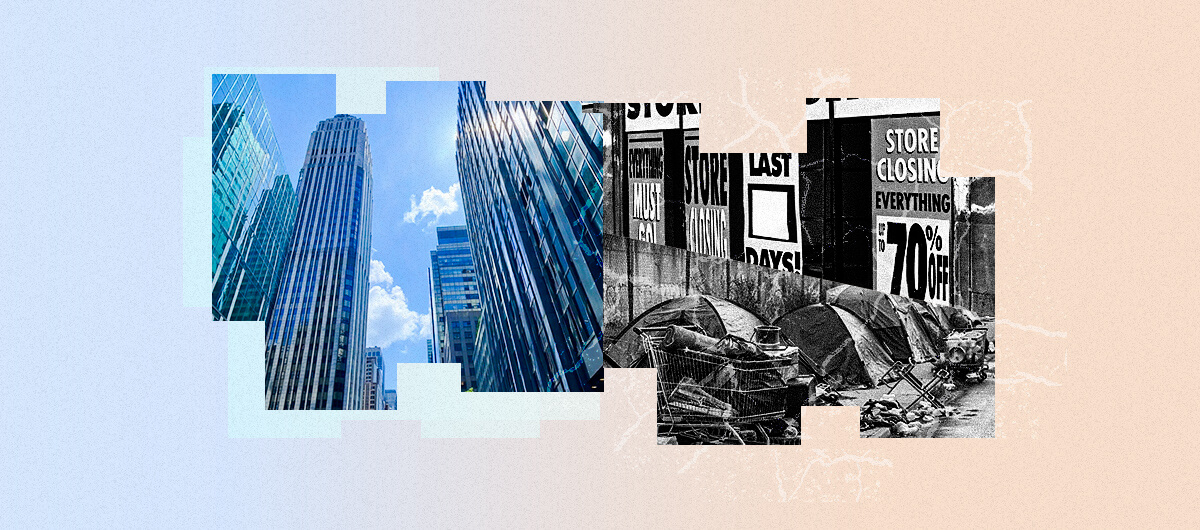
Two years after making that big promise in Michigan, city-dwellers are still waiting for Trump to work with Democrats, or anyone else, to revitalize the nation’s struggling urban centers. Instead of recovery, Trump’s economic policies have saddled cities what economists call the “K-shaped economy,” a pernicious blend of tax cuts, corporate handouts, and housing deregulations that improve the lives of the rich — the upper swipe of the K — while middle- and working-class people lose ground.
Under Trump, cities are increasingly defined by two groups: a microscopic ruling class of the prosperous rich and a restless, unhappy financially insecure mass of everyone else. Those worlds are increasingly coming into conflict in cities across the country. Lacking both ideas and intellectual interest in the problem, Trump and his invisible Housing Secretary Scott Turner are happy to make America’s crumbling cities someone else’s problem.
Trump’s War at Home
Despite his big words in Michigan during the campaign, Trump is committed to crushing urban centers that he clearly believes are little more than hives of Democratic voters and anti-MAGA sentiment. He’s right: while Trump won rural voters by a two-to-one margin in 2024, he lost major city centers by nearly the exact same amount. Even with a supermajority of city dwellers against him, Trump still managed to improve his performance in urban centers by about 8 points over 2020.
It didn’t take long for Trump to put cities in their place. Working through the Elon Musk-led Department of Government Efficiency (DOGE), Trump authorized the cancellation of over $28 billion in federal grants to the cities that most vocally opposed him. The scope of the cuts was mind-boggling and seemingly random. He snatched back $18 billion for two major New York infrastructure projects backed by Senate Minority Leader Chuck Schumer. He abruptly ended $7.5 billion in approved grants for 223 energy projects underway across more than a dozen states. He even gutted a $1.2 billion hydrogen energy research program supported by western Republicans, ending one of the only bipartisan clean energy research efforts in the country. In total, economists estimate Trump’s cuts cost cities an estimated $100 billion in economic activity.
Trump’s hand extended far beyond stripping money from infrastructure programs that made local Democrats look good. In his first 100 days alone, Trump directed his deputies to void over 350 community grants for initiatives addressing gun violence, sex trafficking, opioid addiction, early childhood abuse, and violence against women. In major cities like New York and Los Angeles, roughly one in every three local nonprofits faced an acute funding shortfall that required either staff layoffs or service reductions. As cities’ social safety nets frayed, Trump’s team moved in for the kill.
Nonprofits with the resources to survive the grant cuts soon found themselves face-to-face with a White House committed to their collapse. Trump issued strict new anti-DEI policies that barred nonprofits from receiving any federal funding unless they repudiated the diversity, equity, and inclusion policies that Republicans dismiss as left-wing “wokeness” gone mad. Facing costly federal investigations over their diversity hiring, even more nonprofits shut their doors.
In justifying his attacks on city social services, Trump made explicit a racism that had long existed as euphemism and suggestion within the Republican Party. He focused his rhetoric on Black mayors of major cities like Chicago’s Brandon Johnson, Washington, D.C. ‘s Muriel Bowser, and Los Angeles’ Karen Bass. When Trump began dispatching National Guard troops and ICE agents into Democrats’ urban strongholds, he focused almost exclusively on cities led by Black women. The result paralyzed cities that were finally recovering from the disastrous Covid years.
As community aid organizations vanished, so did the food banks and clothing pantries they sustained. Cities fell into a hunger crisis that included not only those at or below the poverty line but a growing number of middle-class young people and families devastated by rising inflation and the economic costs of Trump’s global tariff wars. Just as more well-off Americans were facing chronic hunger for the first time in their lives, the U.S. Department of Agriculture announced $1 billion in funding cuts to city food bank support programs and the Local Foods for Schools program.
Then the economy stopped.
The Unaffordable City
To enjoy a sustainable quality of life in a major American city requires you to have one of two things — or both, if you’re looking to live especially well: generational family wealth or a high-paying job in one of the few sectors of the economy still paying six-figure wages. Even landing that great, high-paying job is, on its own, no longer enough to guarantee any level of comfort.
Data firm SmartAsset calculated that a single worker living in New York City would need an annual income between $140,000 and $180,000 to meet expenses while putting away a modest savings. The average required income across all major cities is $95,000, more than twice the national real median personal income of $45,000. It isn’t just global hubs like New York and Los Angeles that are surging out of reach for most people, either. Cities like Idaho Falls, Idaho, Tucson, Arizona, Madison, Wisconsin and Melbourne, Florida are experiencing their own housing affordability crises.
Most city residents aren’t rich. They work in service jobs that keep the city running for those with the money to enjoy their leisure time. Trump’s economic tailspin has devastated the financial heart of cities, to the point that New York City-based companies all but stopped hiring in 2025 for the first time in over two decades. Nationwide layoffs walloped cities, leaving middle-class and even wealthy workers unemployed and unable to find comparable jobs. Once-stable families did the math and realized they could no longer afford to live in their own homes. Yet there was no other housing. There was nothing.
No city in America has enough affordable housing to meet current needs, let alone future demand. Los Angeles is over 240,000 units short on affordable housing. The housing that does exist is often in poor repair due to a lack of funds. New York needs over 560,000 new affordable housing units by 2030 to keep pace with the 50 percent of city renters who are spending more than a third of their income on rent alone. Meanwhile, the city’s infamous public housing authority has left many buildings to rot while families still live in them.
Building and expanding public housing takes money, and Trump has delighted in making it harder both for cities to get critical public funds and for residents to qualify for public housing slots. In March, the Department of Housing and Urban Development proposed new federal rules that would impose harsh work requirements and strict residency time limits on recipients of public housing vouchers. The Center on Budget Policy Priorities estimates that the new rules could kick as many as 3.7 million people out of rental assistance programs that serve major cities.
Trump’s proposed 2027 budget slashes HUD by 13 percent, including stiff reductions to federal rental assistance and public housing funding programs. He also slashes one of the federal government’s most untouchable programs through a proposal to cut $72 million from the popular Supportive Housing for the Elderly program. Project-Based Rental Assistance, which provides Section 8 public housing to city dwellers, will see its budget slashed by over $900 million. It’s an indication of just how brutally Trump has punished city housing programs that this year’s proposed budget is less painful than it could have been. A year prior, Trump tried and failed to slash rental assistance programs by 43 percent.
A Tale of Two Cities
Cities like New York and Los Angeles are now places where only the independently rich have the resources to thrive. Trump has lavished those lucky few with tax cuts and new financial loopholes that ensure cash-strapped cities receive little in the way of income tax revenue from their richest residents. While middle-class families line up at the few remaining big city food pantries, the rich are spending on luxury goods at the fastest rate in modern history.
The K-shaped economy is a useful mental image. The rich ride one line of the K into financial heaven, largely ignorant to and disdainful of the problems their neighbors face. Everyone else rides the other line directly into the ground. For a growing number of Americans, the only question is how long they can slow the slide before finally hitting bottom. What Trump doesn’t realize — or doesn’t care about — is that those millions of city-dwelling Americans are about to take the rest of the economy with them when they reach the ground. By crushing America’s cities, Trump has started a ripple effect that will tear the shingles off of suburban and rural communities that depend on the economic dynamism of big cities like Los Angeles, Chicago, Miami, and New York. Look closely at the latest economic data and you can already see the rooftops quaking.
Trump’s war on cities began, as all things with him do, as petty partisan vindictiveness with a dash of racism thrown in. It will end with the country facing its most complex financial crisis in a generation, where the urban engines of American innovation have been starved to the point of collapse and hollowed out for the enjoyment of the plutocratic rich.
Standing in an airplane hangar in Michigan during the heat of the 2024 campaign season, Trump warned us that America’s cities have been waiting decades for someone to shake things up. Few at the time could have imagined the destruction from the political earthquake he would unleash
Before you go, we hope you’ll consider supporting DAME’s journalism.
Today, just tiny number of corporations and billionaire owners are in control the news we watch and read. That influence shapes our culture and our understanding of the world. But at DAME, we serve as a counterbalance by doing things differently. We’re reader funded, which means our only agenda is to serve our readers. No ads, no both sides, no false equivalencies, no billionaire interests. Just our mission to publish the information and reporting that help you navigate the most complex issues we face.
But to keep publishing, stay independent and paywall-free for all, we urgently need more support. During our Spring Membership drive, we hope you’ll join the community helping to build a more equitable media landscape with a monthly membership for as little as just $1.00 per month or a one-time gift in any amount.