


Law
How Congress Can Take Back Its Power Over the Courts
Congress has the constitutional power to expand the lower courts, reshape the Supreme Court, limit its jurisdiction and restore checks on an increasingly powerful judiciary.
This article was made possible because of the generous support of DAME members. We urgently need your help to keep publishing. Please join us for as little as $1.00 a month or make a one-time gift in any amount!
When Democrats retake power, fixing the federal courts has to be a top priority.
The conservatives on the United States Supreme Court are wholly in thrall to President Donald Trump and have warped the judiciary so they can grant his most anti-democratic wishes.
Fixing this requires a whole-of-government approach, a rebalancing of the separation of powers. Because we’re not just in an Article III constitutional crisis. The problem isn’t just the judiciary, and it can’t be fixed at that level alone. We’re also in an Article II crisis: a unitary executive where all power is concentrated in the executive, and a deeply unpopular one. And we’re also in an Article I crisis, because Congress has abdicated its role to check and balance the other branches.
Solving this requires Congress to step up and fulfill its constitutional duty, which is really a duty to all of us. But what does that look like in practice? Congress has a range of powers it can use to reassert its role in checking the executive and judicial branches — and the stakes of whether lawmakers are willing to use them have rarely been higher.
Expansion of Lower Level Courts
The Constitution is not a static document but a living one, available to us to serve as the basis for radical change. We’re not fated to live this way forever, under the thumb of captured, capitulated, compromised courts, especially because the Constitution says very little about the federal courts. Article III vests judicial power “in one supreme Court and in such inferior Courts as the Congress may from time to time ordain and establish.” So, it mandates a single Supreme Court but gives Congress the power to go buck-wild and create lower courts.
First, the federal courts must be expanded, period. We need, at a minimum, dozens more lower court judges. This would be true even if the Supreme Court had not debased itself and joined Trump in his project of dismantling democracy. Indeed, it would be true even if Kamala Harris had won in 2024.
The Supreme Court gets to pick and choose what cases to hear, and hears vanishingly few. Federal district courts and circuit courts of appeals, however, are courts of right, meaning they must hear all cases that come before them.
At the end of 2025, over 432,000 civil and 109,000 criminal cases were pending in the district courts. On average, civil cases take nearly three years to get to trial. The only reason lower court judges aren’t completely buried in criminal cases is that defendants plead guilty in nearly 90 percent of all cases. An additional 8 percent are dismissed for various reasons.
Only Congress can increase the number of federal judges, and that used to happen with relative frequency, but there hasn’t been any meaningful expansion since 1990, even as filings have continued to increase.
In August 2024, the Senate unanimously passed a bill adding 63 new judges, but the GOP-controlled House sat on it until after Trump won the election. This forced then-President Joe Biden to either veto an objectively good bill or turn even more of the federal judiciary over to Trump. A future Congress, however, could take up this sort of expansion at any time. Failing to do so leaves civil and criminal litigants stuck in an overloaded, nonfunctional system.
But make no mistake: expanding the lower courts is also a way for a future Democratic administration to rebalance the composition of the federal courts. Trump appointed 245 federal judges in his first term and, while the second term has seen a bit of a slowdown, he’s still stuffing hardliners into lifetime seats. Thus far in his second term, 90 percent of his appointees are white, and almost 75 percent are men.
Unsurprisingly, this is the exact opposite of what happened under Biden. 63 percent of his appointees were women, 60 percent were non-white, and 20 percent had served as public defenders. Biden’s appointments reflected an attempt to make the judiciary look more like the people it serves, and it’s vital that future Democratic administrations take up that mantle.
Expanding the Supreme Court and Imposing Term Limits
The makeup of the Supreme Court is also not static, a precious belief handed down by the Founders that must be preserved at all costs. There’s nothing in the Constitution setting the number of justices, nothing magic about the number nine. Indeed, from 1789 to 1869, Congress changed the number from six to five, back to six, then to seven, then to nine, then to ten, back to seven, then to nine, and has remained there for over 150 years.
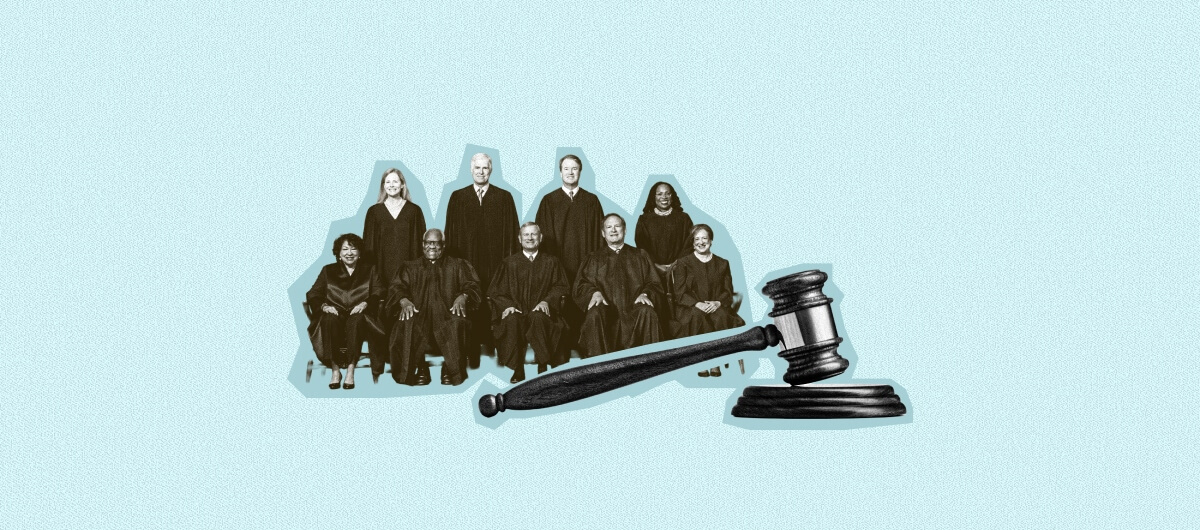
Call it expansion or call it packing the court, but the Supreme Court must get bigger than nine. The Circuit Judges Act of 1869 fixed the number of justices at nine to match the nine federal circuits, with each justice overseeing one. Back then, America had only about 38 million people and only 37 states. We now have over 342 million people, 13 more states, and four more federal circuits. These days, both Justice Samuel Alito and Chief Justice John Roberts have to double up, overseeing two circuits each. It’s absurd that the court’s membership has remained frozen in the face of all this growth.
Given that the 1869 Act tied the number of justices to the number of circuits, it’s completely reasonable to increase the court to 13 members to similarly align.
But why stop there? The International Court of Justice has 15 judges who are elected to nine-year terms. The Court of Justice of the European Union has 15 judges who serve renewable six-year terms. Nothing is stopping Congress from adding four seats, six seats, ten seats, you name it.
Talk of court-packing can cause consternation, even among people who recognize the need for reform. To be fair, increasing the size of the court could trigger an arms race where a future Republican Congress would add even more seats, packing on top of packing. However, that isn’t really any worse than the status quo, where we already have a court packed with a GOP supermajority.
Unlike court packing, imposing term limits on Supreme Court justices should be uncontroversial, because lifetime seats are just not really a thing anywhere else. Save for Rhode Island, every state limits the term of state supreme court justices, whether by requiring re-election, imposing a mandatory retirement age, or both. Additionally, every other major democracy restricts how long judges can serve on its highest court.
Most court reformers propose staggered 18-year term limits, where Supreme Court seats would open in the first and third years of every presidential term. Each president would get two appointments in a four-year term, no more, no less.
However, Article III does seem to give judges and justices lifetime appointments, saying they “shall hold their Offices during good Behavior.” Term limit proposals address this by bifurcating judicial service. A justice would sit on the Supreme Court for 18 years, but when their term expired, they would become a senior justice. Senior justices would not decide regular Supreme Court cases but would instead serve as a resource for the federal judiciary, hearing cases in lower courts and helping with administrative matters for the rest of their lifetime appointments. If an unexpected vacancy arose because a justice retires or passes away, a senior justice would fill in until the expiration of the term.
Imposing term limits on Supreme Court justices should also be uncontroversial, because an overwhelming bipartisan majority—74 percent—supports the idea. Term limits ensure that all justices have the same length of time to impose their judicial vision, rather than encouraging Trump’s present behavior, which is to appoint younger and younger hardliners in the hopes that they will serve for decades. It also ensures that each president has an equal opportunity to shape the Supreme Court’s direction.
Congress’s Most Powerful Tool: Jurisdiction.
Congress also holds considerable power over which cases the courts can hear. The Constitution gives the Supreme Court original jurisdiction “over Cases affecting Ambassadors, other public Ministers and Consuls, and those in which a State shall be Party.” These go directly to the Supreme Court, and Congress can’t change that. However, in all other cases, the Supreme Court has only appellate jurisdiction, reviewing decisions of lower courts. That jurisdiction is subject to “Exceptions, and under such Regulations as the Congress shall make.” Congress has the power to strip the Supreme Court—and the lower courts—of jurisdiction over certain types of cases, barring judicial review entirely.
Congress has already done this in narrow ways. In 2023, Congress passed a law stating that it had ratified and approved everything necessary to build a natural gas pipeline from West Virginia to Virginia—permits, biological studies, agency authorizations, and so on. The law went on to say that “Notwithstanding any other provision of law, no court shall have jurisdiction to review” any challenges to the statute.
A future Democratic Congress could use this sort of move for good, rather than to push through an unwanted pipeline. Imagine another Green New Deal that barred the courts from entertaining challenges to well-settled climate science, saying Congress had already approved everything. Or a law codifying the right to privacy, ensuring abortion access and protecting same-sex marriage, one which also says that the law is not subject to any judicial review.
Congress also has the power to channel jurisdiction, requiring cases to be heard in certain courts or to create a new type of lower court to hear specific cases. States do this often. Minnesota has treatment courts, for example, which handle some criminal cases when the defendant has a substance use disorder. Many states now have a Veterans Treatment Court, which hears cases where a non-violent crime was committed by a veteran struggling with mental illness. Texas recently created a business court to handle complex business disputes.
During World War II, Congress created the Emergency Court of Appeals to hear cases arising under the 1942 Emergency Price Control Act, prohibiting any other court from hearing challenges to wage or price regulations. Congress later expanded it to cover additional laws and then eliminated the court in 1962.
In the wake of Watergate, Congress passed the Ethics in Government Act, which created the Special Division of the U.S. Court of Appeals for the District of Columbia. If the attorney general made a preliminary determination that a high-ranking government official violated a federal criminal law, they could request the Special Division appoint an independent counsel to investigate and prosecute the matter. This arrangement eliminated the inherent, massive conflict of interest in having the executive branch investigate itself, and in 1988, the Supreme Court ruled it was constitutional.
Whoa. We could sure use something like that these days. Too bad it had a sunset provision and expired in 1999, but nothing is stopping Congress from doing something similar again. And let’s face it: we have the most corrupt executive branch ever, run by the most corrupt president ever, with the most compromised Department of Justice ever. They cannot be trusted to self-police, and Congress shouldn’t even let them try.
The reform measure that likely stands the best chance of succeeding is the one that sounds the most boring on its face: term limits. Pragmatically, it enjoys the most support of any proposal, which could make it easier to achieve. Practically, it may feel far more incremental and far less impactful than other options. However, while the change to the Supreme Court’s membership would not be immediate, the effect on the nomination process would be. No more lying awake nights worrying that one of the liberal justices could unexpectedly die, giving Trump a fourth pick for the court. No more worrying that a conservative justice would strategically retire so Trump could replace them with a younger model.
It’s suboptimal that we have to rely on a wholly dysfunctional Congress to fix the wholly dysfunctional courts, but at least these proposals can be implemented by statute rather than amending the Constitution. The midterms could usher in folks with the fortitude to fight like hell, if we elect them.
Before you go, we hope you’ll consider supporting DAME’s journalism.
Today, just tiny number of corporations and billionaire owners are in control the news we watch and read. That influence shapes our culture and our understanding of the world. But at DAME, we serve as a counterbalance by doing things differently. We’re reader funded, which means our only agenda is to serve our readers. No ads, no both sides, no false equivalencies, no billionaire interests. Just our mission to publish the information and reporting that help you navigate the most complex issues we face.
But to keep publishing, stay independent and paywall-free for all, we urgently need more support. During our Spring Membership drive, we hope you’ll join the community helping to build a more equitable media landscape with a monthly membership for as little as just $1.00 per month or a one-time gift in any amount.