


LGBTQ Rights
The Next Front in the Fight for Trans Rights Is the Courts
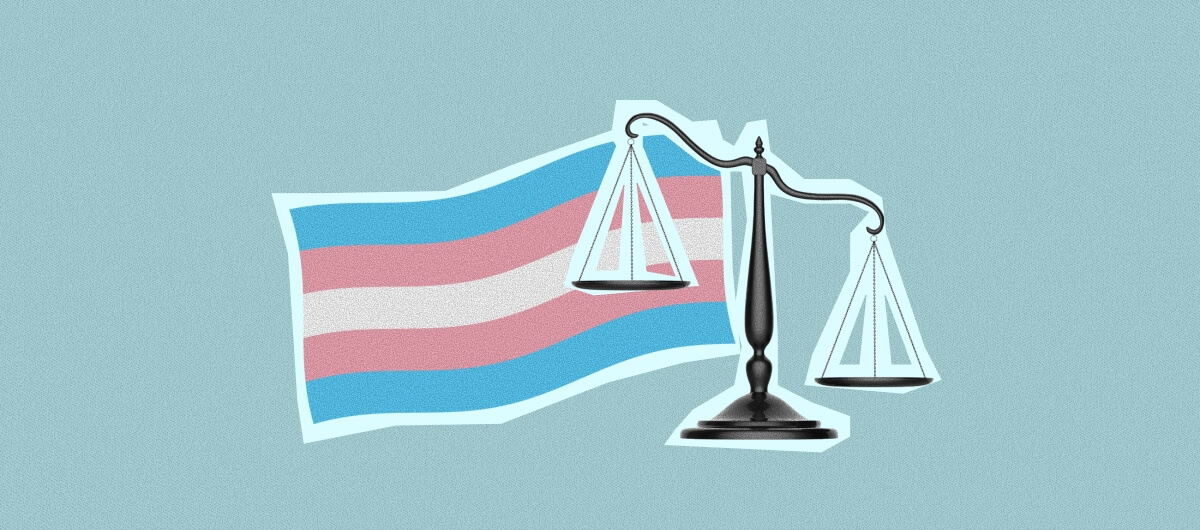
The pending transgender athlete cases reveal how a decades-long conservative effort transformed the judiciary and why reform has become central to the fight for civil rights.
This article was made possible because of the generous support of DAME members. We urgently need your help to keep publishing. Please join us for as little as $1.00 a month or make a one-time gift in any amount!
By the end of June, we will see the Supreme Court issue its decisions in West Virginia v. BPJ and Little v. Hecox, determining whether or not trans people can be excluded from playing sports based on their gender identity. It’s highly expected that the Court will hand down at least a 6-3 decision upholding the validity of such bans on transgender athletes, but the question remains how far the Court will go and how expansive the decision will be in affecting the lives of transgender people. These cases are not just about sports because they involve the application of constitutional protections under the Equal Protection clause and Title IX statutory protections. A catastrophic decision could result in language that all but endorses and mandates bathroom bans across the country, along with strict segregation of sexes assigned at birth in federally funded educational settings.
This follows on the heels of U.S. v. Skrmetti from last year, where the Supreme Court applied rational basis review—the lowest level of constitutional scrutiny—to the state bans on access to gender-affirming care by trans youth. While that decision was determined on the pretext that it was about medical condition and age, BPJ will likely consolidate the doctrine and be used as a roadmap for upholding any discriminatory policy levels against trans people as long as it uses the pretext of “biological sex.”
The past year and a half under the Trump administration has already been extremely bleak for trans people, but now all of the policies that the Trump administration and dozens of red states have enacted will likely be upheld for generations. What follows is essentially a lost generation for trans people and their rights if something doesn’t change. Contrary to the arguments by many reactionary centrists, we didn’t get here because trans people reached too far or were too mean on Twitter to journalists. Instead, we got here the same way we lost abortion rights: a 50-year project to capture the Courts and ensure that the only outcome is the one that ideologically aligns with the Republican Party’s platform.
This project can be traced back to the 1971 Lewis Powell memo to the U.S. Chamber of Commerce. It laid out an explicit strategy for pro-business and conservative ideologues to utilize the courts to implement political change. Powell was soon after appointed to the Supreme Court by President Nixon. In 1982, the Federalist Society was founded at Yale and soon became the ideological grooming organization for conservative judicial nominations. This was supplanted by over $1.6 billion in spending by Leonard Leo to explicitly push the courts in a pro-corporate and socially conservative direction. The Trump administration outsourced its judicial vetting to Leo’s network to fill over 200 judicial appointments and three Supreme Court seats. All six of the of conservative supermajority on the current Supreme Court are current or former members of the Federalist Society.
The anti-trans side has collectively spent over a billion dollars in the last few years alone to push a message hostile to the existence of transgender people and captured numerous institutions to act on that message. The 2024 election saw nearly a quarter billion dollars spent by the Trump campaign alone on anti-trans ads that appeared during high profile events such as Sunday Night Football and the World Series. The ADF has spent tens of millions drafting, lobbying, and litigating anti-trans legislation that targets everything from health care access to bathroom usage and pronouns. The Heritage Foundation compiled Project 2025 which had as one of its central tenets eliminating transgender people from society. Sympathetic organizations such as Family Research Council, the Family Policy Alliance, and Moms for Liberty all helped galvanize support for anti-trans policies to pass in statehouses. The pipeline ran from these think tanks and conservative groups to the Supreme Court, which put its stamp of approval on it.
The only path forward for trans people is to be ruthless in our resistance to this effort and this process. But it also means that we must be pragmatic in how we respond to this backsliding within an authoritarian regime. The response to the BPJ decision isn’t necessarily to retreat in our demands for equal rights or liberation. Instead, we must plan to utilize power to tip the balance back toward democratic institutions that will allow us to once again enshrine rights into the constitutional doctrine.
We must think beyond simple arguments around scrutiny standards and instead realize that the limiting factor toward winning in the courts has been their ideological capture by the far right. We cannot win in such a rigged forum. Human rights do not flow from better constitutional arguments before the courts, better framings of the issues, or poll tested talking points; they flow from the implementation of political power.
Change begins with court reform
The path forward is clear for trans rights and the rights of all marginalized minority groups under the current system. The Supreme Court and the federal courts as a whole must be completely reformed in order to better serve as a government body that is responsive to the needs of modern marginalized communities rather than those of corporate power. This means implementing an expansion of the Supreme Court to a minimum of 13 seats, reflecting the number of Circuit Courts, allowing a democratic president to appoint four new justices to have the first liberal majority since the Warren court of the 1960s. We should seek strict term limits that relegate Supreme Court justices back to circuit courts after 18 years. Or reaching the age of 70 should limit the impact of the direction of our nation’s jurisprudence on the pulse of any single justice. We must also ban membership of federal judges in ideological groups, such as the Federalist Society and the American Constitutional Society, because they fundamentally pervert the purpose of the legal profession. This would be just a start, but it would allow civil rights litigation to gain a foothold once again.
The idea behind expanding to 13 justices is rooted in the history of the court as up until the Civil War. The Court always had the same number of justices as circuit courts of appeal, which at the time, was nine. There are now 13 circuit courts while the number of justices has remained at nine. The Judiciary Act introduced by Senator Ed Markey would restore the historical link by ensuring that each circuit is assigned one Supreme Court Justice to oversee it. The Brennan Center for Justice has endorsed the 18-year term limit upon which justices would be mandated to enter senior status on a circuit court after their term ends. That can help eliminate the dominance of any particular president in appointments while minimizing the pressure of justices to stay on to wait for ideological allies to replace them. The Judicial Conference Committee on Codes of Conduct in 2020 nearly passed its ban on membership in ideological organizations such as Federalist Society until those very members revolted and axed the proposed rule. Congress can eliminate this self-interest problem and ban membership outright. These are all structural reforms that are designed to restore democratic accountability back to the judiciary and eliminate the institutional capture of it by ideological forces.
As the shenanigans in the Northern District of Texas have shown—especially with regards to accessing the medical records of trans youth in states as far away as Rhode Island—it is not enough to engage in Supreme Court reform and call it a day. The district and circuit courts must also be substantially reformed. Single judge divisions within districts must be eliminated to end judge and forum shopping. The circuit courts themselves need to be rebalanced to eliminate the complete ideological capture of circuit courts such as the 5th, 6th, and 11th circuits that are beginning to utilize their power to dictate policy in a far right manner for the rest of the country. The judiciary should be substantially expanded, both to allow for more balanced judicial appointments and to decrease workloads for judges and to allow for more expeditious resolution of court cases.
Hungary: Where Court Reform Worked
The contemporary example of Hungary is relevant here. Former Prime Minister Victor Orban and his Fidesz party spent 15 years manipulating and capturing every major government and civil society institution within Hungarian society to ensure the political opposition could no longer competitively operate. Orban also spent that time whipping up a fervor against LGBTQ people, and as a result, passed substantially regressive legislation that eliminated the discussion of LGBTQ people in the presence of minors, banned the legal recognition of trans people, banned gender affirming care for trans youth, and banned the public gathering of any LGBTQ group including for pride events.
Does that sound familiar? Since 2021, state legislatures across the U.S. have introduced thousands of bills targeting trans people including: bans on gender-affirming care for minors in 26 states, bathroom restrictions in over 20 states, bans on identity document changes, and bans on trans students playing sports that align with their gender identity. Many of these laws, such as the infamous “Don’t Say Gay” passed in Florida in 2022, were modeled directly on the Hungarian ban on LGBTQ content which itself was modeled on the Russian gay propaganda law passed in 2013. The Trump administration has subsequently picked up the baton and enacted its own sweeping vision as part of Project 2025 to fully purge transgender people from society. The Trump administration has: issued an executive order eliminating the federal legal recognition of trans people, directed the Justice Department to target gender affirming care providers, revoked Title IX protections for trans students, banned trans people from the military, eliminated the ability to change gender markers on federal documents such as passports, implemented a federal building bathroom ban, ended all investigations at the EEOC into discrimination against trans employees, and eliminated coverage for gender affirming care on federal health plans.
The issue with Orban’s assault on LGBTQ people is that it blatantly violates its obligations to the European Union under the European Convention of Human Rights and under the European Court of Justice. The Hungarian government under Orban had lost a number of cases related to treatment of minority groups in EU courts, but Orban’s government refused to implement them.
While Orban lost the election to Peter Magyar earlier this year, that doesn’t fundamentally change the legislation that was passed nor does it promise to be a panacea for a more progressive government (Magyar is a conservative himself). But it does allow for the enforcement of EU law to abrogate anti-LGBTQ laws passed by Orban’s government and the enforcement of judicial decisions by EU courts within Hungary. The simple act of allowing EU court decisions to be recognized in Hungary again will allow LGBTQ groups within Hungary to reclaim the ground they lost and expand upon the human rights framework.
The example here is that you must allow for democratic institutions to thrive once again once liberal parties retake power from authoritarian leaders. It is only under these liberal institutions that marginalized groups can hope to win back fundamental rights in courts receptive to human rights frameworks.
We cannot undo the damage of a 50-year project to capture the courts without using actual political power to rebalance the scales of justice. Similarly, expanding the Supreme Court will not result in automatic decisions that clear a path for queer and trans liberation. What it will do is allow space for fairness before the Court. That breathing room is what allows us to organize more broadly within our community to address the material needs that are deeply affected and downstream of these court decisions.
And the infrastructure is already being built up. Liberal organizations have begun promoting court reform proposals. Groups such as the American Civil Liberties Union (ACLU), Lambda Legal, and Democracy Forward have consistently litigated the worst excesses of this administration and laid the groundwork for better jurisprudence under a more favorable court. Reversing bans on accessing health care or even using the bathroom that aligns with our gender identity will not make it so that we aren’t discriminated against in society or eliminate the substantial disparities in health, employment, and economic security. It will, however, allow us to better participate in society, and to be able to do the work that will eliminate disparities and put us on a path toward liberation.
Before you go, we hope you’ll consider supporting DAME’s journalism.
Today, just tiny number of corporations and billionaire owners are in control the news we watch and read. That influence shapes our culture and our understanding of the world. But at DAME, we serve as a counterbalance by doing things differently. We’re reader funded, which means our only agenda is to serve our readers. No ads, no both sides, no false equivalencies, no billionaire interests. Just our mission to publish the information and reporting that help you navigate the most complex issues we face.
But to keep publishing, stay independent and paywall-free for all, we urgently need more support. During our Spring Membership drive, we hope you’ll join the community helping to build a more equitable media landscape with a monthly membership for as little as just $1.00 per month or a one-time gift in any amount.