


Foreign Policy
What the War on Terror Built
Two decades after 9/11, the outcomes of U.S. military interventions in the Middle East—from ISIS to regional instability—raise hard questions about cost, accountability, and repetition.
This article was made possible because of the generous support of DAME members. We urgently need your help to keep publishing. Please join us for as little as $1.00 a month or make a one-time gift in any amount!
In 2001, I sat in a diaper and onesie, watching the World Trade Center collapse on CNN. I was barely a year old, and obviously unaware the carnage on that TV screen would be the catalyst for two major wars; justification for expanding the surveillance state; hundreds of thousands of dead Iraqis, Afghans, and Americans; and trillions more dollars added to the U.S. national debt.
Almost two and a half decades later, in 2024, I visited Iraq with a Slovenian journalist friend named Mihael. From Baghdad International Airport, our taxi driver sped down the very road where the Iranian military officer Qasem Soleimani had been killed by a Trump-issued airstrike just a few years prior. To commemorate his death, a large mural stood in the spot where he was assassinated, featuring the general’s sullen face and the red-lettered words: THE BLOOD OF OUR MARTYRS WILL NOT BE FORGOTTEN.
Later, as our taxi driver maneuvered his way down the block toward our hotel in Baghdad, it was impossible to miss the armored humvees on every corner, where an Iraqi soldier peered out from the vehicles’ vision block with a heavy machine gun.
“What’s up with all the security?” I asked our driver.
“You know Daesh?” he replied over his shoulder.
“Daesh? Like ISIS?”
“Yes, yes. ISIS,” he nodded. “They do a small attack some days ago. But don’t worry. Now, it’s okay.”
My chest suddenly constricted. ISIS was not a group I was keen on dealing with. But this was Iraq, the very place from which the militant jihadist group emerged, metastasized, and eventually spread abroad. ISIS, it should be noted, was an outgrowth from the 2003 U.S.-led invasion of Iraq. David Kilcullen, a former counter-insurgency adviser to U.S. General David Petraeus and Secretary of State Condoleezza Rice, said in a 2016 interview: “We have to recognize that a lot of the problem is of our own making. There, undeniably, would be no ISIS if we hadn’t invaded Iraq.”
So who did I have to blame for my angst in the back of that taxi? According to Kilcullen, it was the U.S. government.
Leaving Baghdad, we drove into the Shia heartland in the country’s south. We traveled through the ancient city of Babylon and past Saddam Hussein’s deserted palace as we headed toward the holy cities of Najaf and Karbala. Mihael was particularly worried about being kidnapped here. That’s because one of the many armed militias that roam Iraq today is the Popular Mobilization Forces, or PMF — an Iranian-backed Shia paramilitary group.
At every checkpoint, Mihael and I would hold our breath and cross our fingers, hoping that the masked, gun-wielding men did not belong to the PMF; and, if they did, that they wouldn’t take issue with us.
Whenever we’d drive along these sandy, desolate stretches of Iraqi roadway, we’d see murals, posters, and even billboards. Some depicted images of then-U.S. President Joe Biden splattered with blood and captioned with the words: DESECRATOR (for his role in Israel’s genocide in Gaza). Others depicted imagery and messaging in support of Qasem Soleimani, the rest of the Islamic Revolutionary Guard Corps, or Hezbollah.
There was, in other words, plenty to be wary about while traveling through Iraq in 2024. ISIS, though degraded, remained a threat. Pro-Iranian forces, like the PMF and Kata’ib Hezbollah (which is technically under the umbrella of the PMF), prowled the deserts, and, at the time, were routinely firing mortars at the U.S. Embassy in Baghdad. In a vain attempt to hide my nationality, Mihael thickened his Slovenian accent, which I hid behind whenever someone asked where we were from.
But wasn’t Iraq supposed to be “liberated?” Isn’t that what the Bush administration had told the world more than 20 years before I got there? In the lead-up to the Iraq War, high-ranking U.S. officials framed the country as a petri dish for terrorist networks, and that an invasion would liberate the people, squash terrorism, and even severe Iranian influence. President George W. Bush said during the 2002 State of the Union: “Iraq continues to flaunt its hostility toward America and to support terror.” Then-U.S. Secretary of Defense Donald Rumsfeld had said, “Iran should be on notice that efforts to try to remake Iraq in their image will be aggressively put down.”
And yet I encountered an Iraq that had barely recovered after nearly being overrun — literally — by one of the most notorious insurgent groups in history. In 2014, Baghdad nearly fell to ISIS after the group captured several major Iraqi cities, including Mosul. Clearly, the U.S. government’s goal of stopping terrorism was, at best, a huge failure.
As for Iran, Rumsfeld’s warning was also toothless. Because since the invasion, Iran has gone on to wield tremendous influence within the Iraqi judiciary and even military. Across the country, Iran has gained a strong political, social, and even militaristic foothold. So that U.S. objective, too, failed.
The threats I faced while traveling through Mesopotamia could be traced back thousands of miles to decisions made in Washington, D.C. The U.S. government, I discovered, is Dr. Frankenstein; many of the monsters that roam the world today are American-made.
So if the Iraq War was, generously, a colossal mishap, what was gained? Besides giving rise to ISIS, spurring a massive refugee crisis, and driving the nation into the hands of Iran, the war cost well over $2 trillion. Hundreds of thousands of Iraqis were killed; more than 4,500 Americans perished, too. For a tremendous human and financial cost, the U.S.-led war in Iraq quite literally achieved the very opposite of what it said it was going to.
Today, as the Trump administration wages war with Iran, one must wonder if, yet again, this latest spout of militarism will enrich a select group of corporate elites, while having ruinous effects within the Middle East, cause more needless bloodshed, and further indebt the United States.
There is no evidence to suggest the outcome of this war will be any different than those that came before it. In late February, the U.S. fired a Tomahawk missile into the Shajareh Tayyebeh girls’ school in southern Iran — more than 165 were killed; most were little girls between 7 and 12 years old (so much for liberating the women of Iran, huh?). Since then, over 1,300 Iranians have been killed by the joint U.S.-Israeli bombardment. Hundreds have been killed in Lebanon; at least 13 U.S. servicepeople have died, and a dozen in Israel.
Environmentally, the toll has been apocalyptic-looking. Toxic black rain — due to oil depot fires — has splattered Iran. Air pollution has been immense, as black smoke has steadily billowed into the sky about Tehran. Financially, the toll has been enormous. The U.S. is spending roughly $2 billion per day to sustain this war; oil prices have surged to $100 a barrel; the violence has caused one of the biggest — if not the biggest — oil supply disruptions in history.
According to the Pentagon, the first six days of the war cost the U.S. more than $11 billion. This means that it cost the U.S. taxpayer billions of dollars to replace Ayatollah Khomeini — who was killed by a U.S.-Israeli strike in late February — by his much angrier, much younger son: Ayatollah Khomeini.
So when U.S. officials tell the public that the war is meant to stop Iran’s so-called terror network, undercut its ability to build a nuclear weapon, or even to “free” the Iranian people, it rings hollow. We’ve seen how this plays out before. What comes next is rarely — if ever — any better.
***
When the U.S. invaded Afghanistan in 2001, the goal was two-tiered: break up al Qaeda’s base of operations, and, to do so, dismantle the Taliban. Rumsfeld said of the war in a 2001 news briefing, “Let there be no doubt; it will end in the comprehensive defeat of the Taliban and the al-Qaeda and the terrorist networks operating throughout the world.”
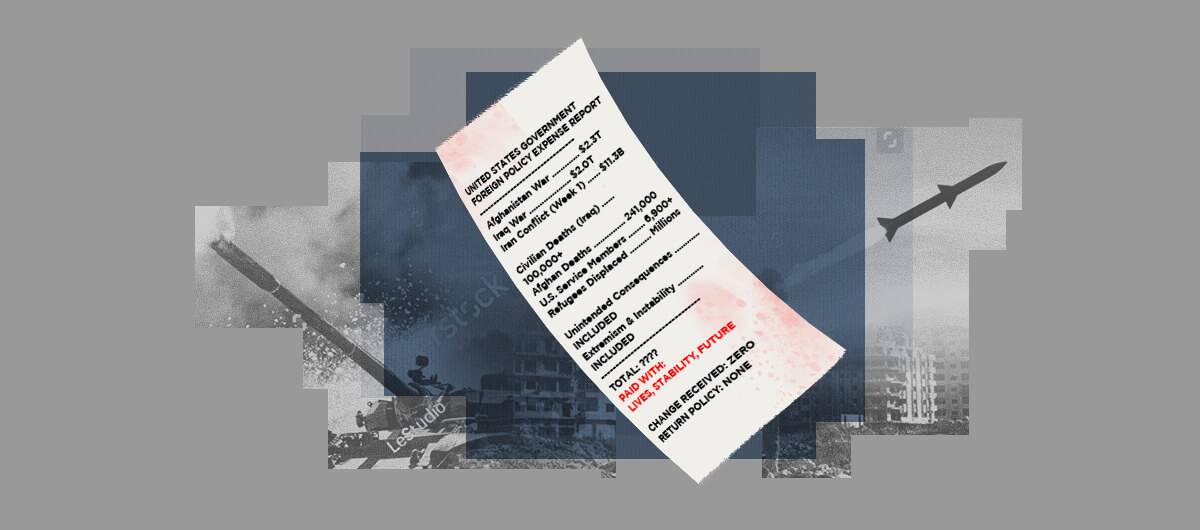
Well, nearly 20 years, $2.3 trillion, 2,461 dead Americans and a staggering 241,000 direct Afghan deaths later, the Taliban resumed power the literal moment the U.S. pulled out. Rumsfeld’s stated aims were evidently in vain: the Taliban swept across the country, easily reclaiming power after 20 years of fighting America. Worse yet, the U.S. left behind about $7.12 billion worth of military gear. More than 600,000 guns, including M16 and M4 rifles, 40,000 tactical vehicles, Black Hawk helicopters, and thousands of pieces of surveillance equipment were left in Afghanistan. Instead of taking out — or even weakening — the Taliban, the U.S. actually empowered it.
Since 2023, I’ve honed my journalistic focus on the parts of the world misshaped by U.S. foreign policy. I spent the summer of 2023 living in Palestine, and have reported and traveled through Iraq, Syria, Lebanon, and Cuba. What I’ve noticed is an enormous gap between what war-hungry American politicians say and what actually happens on the ground.
Today, the U.S.-Israeli war against Iran — codenamed Operation Epic Fury — has stated objectives that bring to mind the supposed aims of the Iraq War. One of the stated goals is to prevent Iran from getting a nuclear weapon (reminiscent of the fear of Saddam Hussein obtaining a WMD). Another objective is to sever Iran’s ties to various regional proxies, like Yemen’s Houthis, Lebanon’s Hezbollah, and the various Shia militias, like the PMF, in Iraq. On March 2, Trump said, “Our objectives are clear (…) to destroy the ability of this regime to launch missiles (…) and to ensure that Iran never obtains a nuclear weapon.”
There’s also been a liberation narrative. Undoubtedly, Iran’s theocratic government is not one worthy of applause (though neither is Israel’s or America’s, for that matter). Whether Iran’s government is oppressive is besides the point; this is a war that violates UN Charter Article 2(4) and lacks Congress’s constitutional power to declare war. Thus, it’s in violation of both U.S. and international law. Not to mention, the U.S. and Israel have committed war crimes against civilians and numerous ancient cultural sites within Iran. This war is, undeniably, illegal.
Killing is an expensive endeavor; in the first 100 hours of the war, it cost the U.S. roughly $3.7 billion. It is plausible that, the longer this goes on, the war could run into the trillions (Secretary of War Pete Hegseth has already requested $200 billion for it). So it begs the question: How long will this illegal war last?
When asked this question by reporters, White House Press Secretary Karoline Leavitt said it could take between four and six weeks. Trump himself said it’ll end either “soon” or “very soon.” Whereas Israeli Prime Minister Benjamin Netanyahu said it will grind on “as long as it is needed.”
None of that should be reassuring. Rumsfeld, in the early days of the Iraq War, assured the public that it would last “six days, six weeks, or at most ‘months.’” It lasted eight years, led to a vicious sectarian civil war, and ultimately gave rise to ISIS.
As of writing, roughly 3.2 million Iranians have already been displaced as the U.S. and Israel continue to lob bombs. Thousands of civilian sites, as well as over 25 hospitals, have been hit. Before the U.S. and Israel attacked Iran, crude oil was selling, on average, at $65-70 a barrel. Since the war began, it’s reached a peak of $126 per barrel.
***
Today, as prices surge, as Iranians are displaced, as south Lebanon is quietly invaded by Israel, as American troops are killed, and as Iranian parents bury their little girls, one must ask: Why? Why are we doing this? How exactly is this improving our lives? Isn’t that what government is supposed to do?
Again, the U.S. spent about $11.3 billion in the first six days of the war. For context, that is more money than the entire $7.4 billion Congress allocated to the National Cancer Institute. With the money used to bomb Iran, the U.S. could’ve paid the yearly salaries of almost 166,000 public schools teachers. It could’ve provided housing to an estimated 1 million homeless Americans for a whole year, or funded full Pell Grants for 1.6 million college students. The money used to kill Iranians could’ve footed the bill for the National Park Service for at least three years; fed 5.5 low-income Americans for a full year; funded a universal free school meal program nationwide for up to three years; modernized every single public library in the country; or expanded internet access to lower socioeconomic regions.
But such things are of no interest to the U.S. government, evidently. I think back to that moment I do not recall — as a child, sitting beside my horrified father on the couch on September 11, 2001, watching the World Trade Center collapse in a fiery inferno. The trillions of dollars my government would spend from that point onward — through my childhood, adolescence, and all through college — could’ve fundamentally reshaped the world we’re living in now. Instead of a ruined Iraq, we could’ve had healthcare, better infrastructure, and improved public education.
Instead, the U.S. kept the war machine’s gears grinding. For it, millions are dead. The national debt ceiling has only soared. We gave birth to ISIS, and helped trigger the greatest humanitarian crisis of the 21st century.
Back in Iraq, I sat in the iconic Shabandar Cafe, on Baghdad’s literary al-Mutanabbi Street. Myself, my European colleague, and an Iraqi contact I had, Ahmed, sat inside, sipping lemon tea.
What Ahmed said to us that afternoon is something I will never forget: “Here in Iraq,” he smiled sadly, “we only discuss the past. Never the present or the future. Because this is a country where the past is better than the future.”
I think about the world I inherited after 9/11, what the U.S. government did to Ahmed’s country, what it’s doing now to Iran, and what we’re doing to our own. Healthcare, education, infrastructure, the environment are all secondary to bombs, missiles, bullets, and drones. And I begin to wonder if Ahmed’s feeling about Iraq applies to the United States, too.
Before you go, we hope you’ll consider supporting DAME’s journalism.
Today, just tiny number of corporations and billionaire owners are in control the news we watch and read. That influence shapes our culture and our understanding of the world. But at DAME, we serve as a counterbalance by doing things differently. We’re reader funded, which means our only agenda is to serve our readers. No ads, no both sides, no false equivalencies, no billionaire interests. Just our mission to publish the information and reporting that help you navigate the most complex issues we face.
But to keep publishing, stay independent and paywall-free for all, we urgently need more support. During our Spring Membership drive, we hope you’ll join the community helping to build a more equitable media landscape with a monthly membership for as little as just $1.00 per month or a one-time gift in any amount.