


Explain This
The AI Data Center Boom Looks a Lot Like the Railroad Bubble
Across the U.S., massive data centers are rising to power generative AI. The hype echoes how the railroad barons once sold their vision of the future leaving the public paying the costs.
This article was made possible because of the generous support of DAME members. We urgently need your help to keep publishing. Please join us for as little as $1.00 a month or make a one-time gift in any amount!
Data centers have exploded into public consciousness in the past two years. In central Ohio, they’re everywhere: 133 are already here, and that number is expected to grow to more than 200 by 2030. With them comes energy infrastructure. In Hilliard, near where I live, the residents will soon have to put up with an extensive gas fuel cell and diesel generator complex that will supply power for an AWS data center. It will emit 1.5 million pounds of CO2 every day, equivalent to about 66,000 cars. It’s sited less than a mile from an elementary school, and the city government had no say because HB 15 in Ohio allows for expedited application and approval of power infrastructure to support data centers. The boom is driven in no small part by the insatiable demands of generative AI: ChatGPT, Sora, Claude, and all of the other language-learning models (LLMs) require vast amounts of computing power, which means very large and very powerful server farms.
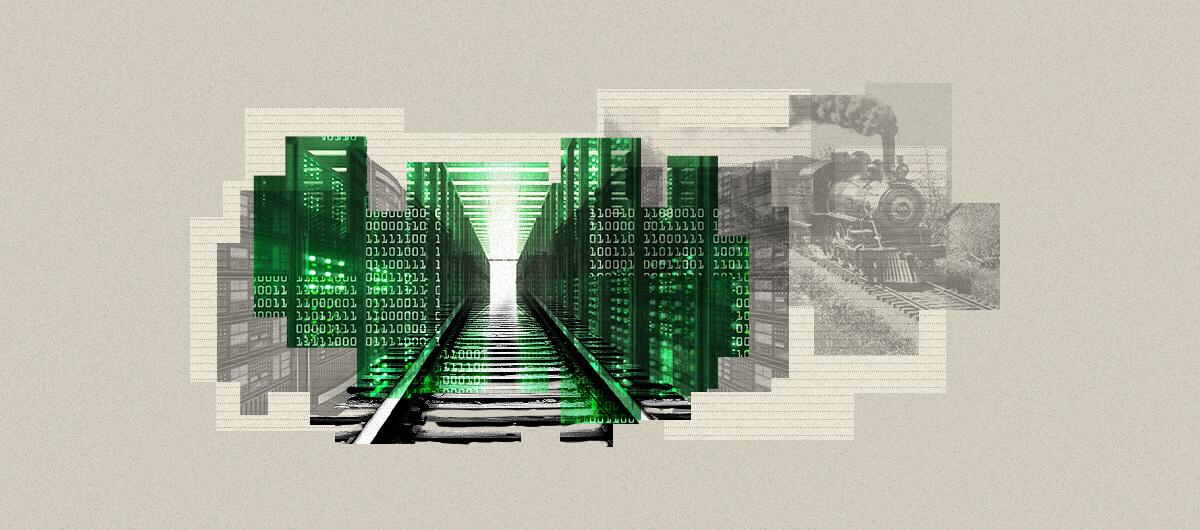
We’re living through a 21st-century version of the railroad boom. We celebrate the building of the railroads today; former President Barack Obama, for instance, loved to repeat the line that “America is the country that built the transcontinental railroad.” We might look back at 19th-century railroads with nostalgia because we can’t seem to build high-speed rail today, or because it harkens back to an era when it seemed like we could make the impossible happen. In truth, the railroad industry was horrifyingly dysfunctional, environmentally destructive, riddled with graft and theft, and above all, unprofitable for all but a few people. AI seems poised to play out in the same way.
Railroads Were America’s First Tech Bubble
Railroad boosters made all kinds of absurd promises the same way that OpenAI, Microsoft, Anthropic, and other Big Tech companies do today. Collis P. Huntington, one of the founders of the Union Pacific, promised, “The one moral, the one remedy for every evil, social, political, financial, and industrial, the one immediate vital need of the entire Republic, is the Pacific Railroad.” More honest was Cornelius Vanderbilt, who said, “Railroads are not run for the public benefit, but to pay. Incidentally, we may benefit humanity, but the aim is to earn a dividend.” The same man also said, “What do I care about law? Ain’t I got the power?”
In total, 129 million acres of land was given to railroad companies by the federal government; 7 percent of the continental United States handed over to about 80 companies. Another 51 million acres came from the states themselves. The companies, controlled by a small group of tycoons, could then sell the land for a profit. This was in addition to government subsidies and bonds, and they set up wild systems for theft. The Union Pacific, for example, was allowed to bill the federal government for expenses, and it set up a fake agency, the Credit Mobilier, that inflated the cost of its expenses, skimmed off the excess, and used the money to bribe Congressmen.
What Americans got in exchange was a deeply dysfunctional industry. Railroads charged different rates to haul cargo and established preferential pricing for large shippers while charging small farmers more. Predictably, this infuriated the farmers who depended on railroads to sell their goods. State governments, especially those in the South, sponsored railroad construction in the hopes that they would open areas up for commercial development and agriculture.
With so many government handouts available to rail builders, tons of companies were formed with the goal of getting rich quick. The two men in charge of the Western North Carolina Railroad took $3 million from the state only to reinvest it in railroad companies in Florida. After 20 years of construction, by 1875, the out-of-state railroad remained unfinished. A nine-mile stretch of the Union Pacific in Nebraska was built in a loop solely so the company could claim an extra $144,000 in expenses; it provided no public benefit whatsoever. Once they were up and running, many railways barely functioned: lines like the New Orleans, St. Louis, and Chicago Railroad often failed to make payroll. Construction was illogical: the Atchison, Topeka, and Santa Fe Railroad built a line two miles away from the Missouri Pacific Railroad. Both started and ended in the same place.
The wildly overbuilt railroads, as explained by historian Richard White, were in the name of “dumb growth”. Where the lines went, they violently displaced Native Americans and slaughtered buffalo. And once they were built, they had to find industries and people to support their existence. The land that the rail companies held varied wildly in what it could be worth. Some of it was well-suited to farming, but in more arid parts of the country, land was opened up that was simply not suitable for long-term agriculture or grazing without extensive public irrigation projects. Farmers tried anyway, lured by promises about supposed fertility and access to easy transportation of goods on the railroads. Most just barely eked out a living. Railroads put a lot of people to work; 2.5% of the population worked for railroad companies in 1880, and that figure kept growing. In that respect, they compare favorably with AI companies that employ very few people. But were the jobs “good”? The sheer number of strikes by railroad workers in the 19th century tells us they weren’t. When easy investment money ran out, companies survived by cutting workers’ wages, sometimes by up to 50 percent. Workplace accidents were common and deadly, and American trains were uniquely dangerous because they moved freight as compared to passengers. The fatality rate for American railroad workers was more than double what it was for British workers.
These companies were overcapitalized, and when the money from banks or anybody else dried up, companies collapsed. In 1873, a major banking firm, Jay Cooke and Co., failed after trying to finance a second transcontinental railroad. What followed was a major financial panic and depression. More than a quarter of all railroad companies nationally went bust; three years later, unemployment nationally was still 14 percent. The industry was no healthier 20 years later; following the Panic of 1893, a quarter of all railroad mileage was in receivership because the previous owners had gone bust.
The people who ran these companies, the tycoons, made money even when their companies were literally and figuratively going off the rails. Most of them depended on the government in one form or another, whether it was for contracts, land grants, subsidies, or when labor disputes got hot, federal officers put down strikes. The Big Tech leaders today are no different: they depend on government support because their companies don’t turn a profit. As time goes on, their debts only grow.
What AI infrastructure actually delivers
How do data centers compare to railroads? For one, they’re also environmentally destructive. Data centers are energy hogs. They accounted for 4 percent of all U.S. energy generation in 2024, and that is expected to more than double by 2030. Most of this energy is coming from fossil fuels, worsening the climate crisis. New gas plants aren’t going to disappear even if the data centers do, and decommissioning them will be incredibly difficult.
The materials for the computers are “rare earth” minerals, named as such because they are almost never clustered in large deposits. They include 17 different metals: lanthanum, cerium, europium, and others. Mining them is incredibly-energy intensive, and separating them out from other minerals generates a great deal of toxic waste. In the Democratic Republic of Congo, it’s an industry that runs on slave labor.
The larger data centers require up to five million gallons of water a day in order to keep themselves cool, and there’s evidence that what they consume can worsen preexisting pollution in water tables. The Trump administration is also working to allow new forever chemicals to be used in data centers.
What benefit do they provide to the public, or society? Not much, as it turns out. The companies that run them take advantage of huge tax breaks so they don’t provide much revenue back to the places they’re located. The number of jobs they offer is pitiful. Once built, the average data center only offers a few dozen jobs, with no guarantee that they go to members of the community. Moreover, AI data centers, especially the GPUs that make computations possible, are under incredible strain: They need replacement every one to 8 years. Railroad construction at least spurred the growth of steel manufacturing, but with the data center boom, the beneficiaries are basically Nvidia and other chip manufacturers.
All the signs of a massive bubble are blatantly obvious, one that looks depressingly familiar to 19th-century Americans. If it bursts, it’s going to inflict a lot of damage on ordinary Americans. It will hit conventional banks and other financial institutions with ripple effects throughout the broader economy. And then there’s the immediate hit to people’s wallets: data centers are driving up electricity costs.
Railroads also wreaked a distorting influence in American life, and they were deeply unpopular. Dislike of the railroads and demands for their regulation led in no small part to the formation of the People’s Party, and two of the largest strikes in the 19th century, the Great Strike of 1877 and the Pullman Strike were aimed at the railroads. They normalized political corruption on a massive scale. Bribes paid to state legislatures and to Congress became a cost of doing business. Similarly today, tech is funding a massive lobbying spree through groups like the Data Center Coalition, or the ways that municipal and state governments try to force them through over the objections of the people who live there.
And yet, data centers are also a unicorn issue in American politics, much like railroads were. Rural Americans hate them, seeing them as an assault on farming, agriculture, and scarce water supplies. People in urban areas dislike them just as much: they bring noise and air pollution, few to no jobs, and are frequently coming with gas turbines like Grok’s Memphis plant that is poisoning a whole neighborhood. The dislike of data centers is bipartisan.
Big Tech and AI companies, in particular, are increasingly throwing their weight behind the Trump administration, but that money comes at a serious cost: it’s hanging a wildly unpopular issue around the administration’s neck. If Democrats are savvy, it would be time to start severing ties with Silicon Valley, calling the bubble what it is, and aligning themselves with the backlash against data centers.
Before you go, we hope you’ll consider supporting DAME’s journalism.
Today, just tiny number of corporations and billionaire owners are in control the news we watch and read. That influence shapes our culture and our understanding of the world. But at DAME, we serve as a counterbalance by doing things differently. We’re reader funded, which means our only agenda is to serve our readers. No ads, no both sides, no false equivalencies, no billionaire interests. Just our mission to publish the information and reporting that help you navigate the most complex issues we face.
But to keep publishing, stay independent and paywall-free for all, we urgently need more support. During our Spring Membership drive, we hope you’ll join the community helping to build a more equitable media landscape with a monthly membership for as little as just $1.00 per month or a one-time gift in any amount.