


Foreign Policy
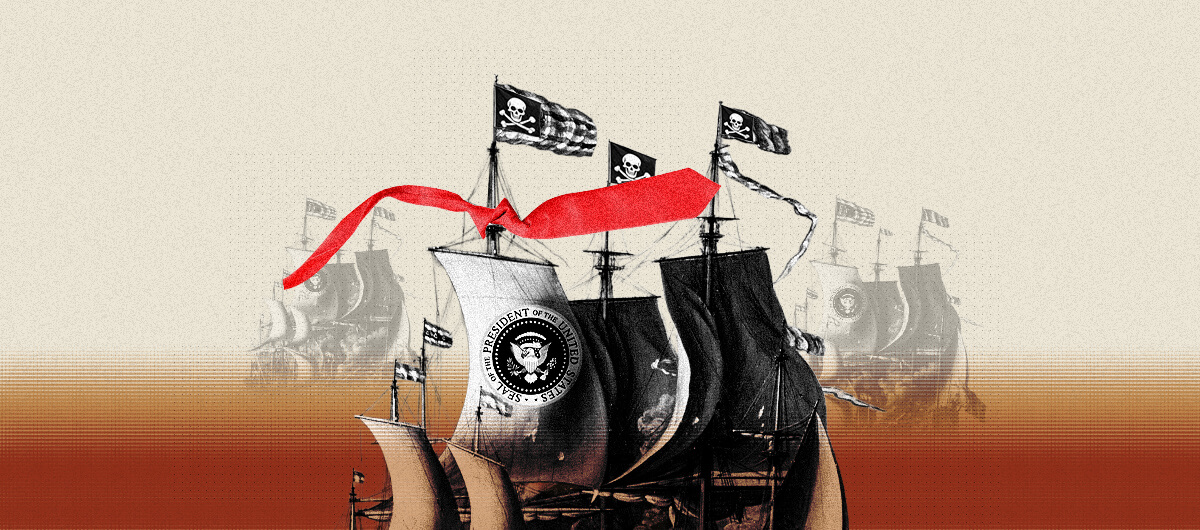
Trump’s Foreign Policy Has a Model: The Barbary Pirates
Trump’s foreign policy treats global alliances as protection rackets reminiscent of historical tribute systems: pay up, submit, or face threats.
This article was made possible because of the generous support of DAME members. We urgently need your help to keep publishing. Please join us for as little as $1.00 a month or make a one-time gift in any amount!
Trump’s foreign policy, often branded as “America First,” can look chaotic and unpredictable to anyone trying to follow it. He routinely rips up or reneges on agreements he made in his first term and demands that a new deal be renegotiated. This would include the 2019 Canada-U.S.-Mexico Agreement (CUSMA), where Trump claims it’s unfair, and now is threatening Canada with massive tariffs, withdrawal from the treaty, and even annexation if Canada doesn’t agree to revise the treaty in favor of the U.S.
Similarly, the Trump administration always hated the corrupt and brutal Maduro regime for being socialist—but mostly for having oil. So, he created pretexts for invading Venezuela, kidnapping Maduro, and replacing him with Vice President Delcy Rodríguez. Rodríguez quickly agreed to Trump’s terms to avoid further kidnappings and killings of Venezuelan leaders: namely putting a large percentage of the country’s oil revenue into a slush fund account in Qatar, which is controlled by the Trump administration. For all of Trump’s talk about liberating Venezuela from a corrupt socialist regime, he was more than happy to leave it in place as long as Venezuela was willing to pay.
This same calculus appears to be in play with Iran. For all the talk of wanting the Iranian people to be free of brutal Islamic theocracy, Trump has also made it clear that he is fine with the current government remaining in place as long as they’re willing to do some sort of deal. However, in their haste to kill people and break things, the U.S. and Israel killed all of the more moderate (or corrupt) senior clerics who would have agreed to terms (most likely involving a cut of Iran’s oil revenue as well). “The attack was so successful it knocked out most of the candidates… It’s not going to be anybody that we were thinking of because they are all dead,” Trump said.
Then there’s Ukraine. Trump always had a soft spot for dictators and Vladimir Putin. One of his first priorities upon returning to the White House was making Ukrainian President Volodymyr Zelenskyy humble himself and kiss the ring while being subjected to a torrent of verbal abuse. The price of even minimal continued support was signing over mineral rights to U.S. companies.
Not that such abasement ended up helping much: the U.S. has effectively ended all financial and military support for Ukraine besides intelligence sharing. Virtually all of Ukraine’s military equipment is now being supplied by the European Union. Putin took this as the green light to throw troops at Ukraine and ramp up casualties to the highest rate seen so far in this four-year war.
Trump’s Foreign Policy Is Purely Transactional
U.S. support for Israel in Gaza came with no strings attached. Trump and Jared Kushner openly salivated at the possibility of turning Gaza into a resort town from which they and other supporters could profit. They never actually said what would be done with the 2 million Palestinians living there currently, but presumably they’d be sent elsewhere whether or exploited as cheap labor as long as they complied.
After years of watching the Trump administration flounder its way through military and foreign policy, their decision making is guided by the following principals:
- There is no such thing as good and bad governments: only those who do as they’re told and those who don’t.
- Every relationship is transactional.
- The strong deserve to, and should, take from the weak as part of the natural order.
- There can be no sympathy for the weak. They exist to be exploited.
- Strength, and a willingness to use it to secure money and power, is an admirable quality.
- The purpose of U.S. diplomacy is to exploit military and economic advantages to pressure everyone into paying what amounts to protection money.
- It is far better to be feared than loved.
- These guiding principles blend the worst aspects of Malthusian and Machiavellian philosophy, under a president who is an ignorant, malignant narcissist. Trump has no need of an experienced Foreign Service Officer corps or foreign policy experts.
- He sees no need for them when he has these philosophies backed up by the largest economy and military (by spending) in the world.
There is no grand ideology behind this, even a pretextual one. During World War II, you could point at fascism, democracy, communism as ideologies that various factions were fighting to spread or protect. The Cold War was ostensibly about democracy, capitalism, and human rights opposing the statist philosophy of communism where the individual was completely subordinate to the needs of the many (or the state, as the case was).
The Historical Parallel: The Barbary Pirates
The closest historical analogy to this foreign policy I can find is the Barbary pirates. They were a loose confederation of kingdoms along the North African coast until the 19th century. Their business model was to extort money from European powers to refrain from raiding their shipping or raiding their shores and kidnapping their citizens as slaves. Alternately, particularly during the Napoleonic wars, they would take money to raid and enslave ships and people from other European powers. In other words, France would pay a kingdom to raid English shipping, or vice versa.
The Barbary pirates were notoriously fickle. They would renege on a deal the instant they thought they could get a better one, or as soon as a better one was offered. Their business model endured from roughly 1600–1830. In general, countries put up with it because they were either too weak to put an end to it (like many of the small Italian states before unification), or it was cheaper to buy them off than amass a small armada to crush them. Additionally, the richer states saw them as useful mercenaries during times of war.
It was not until the United States gained independence from Britain that their fortunes began to shift. After the U.S. gained independence, it lost the protection of the Empire, and the Barbary pirates took advantage. Rather than cutting a deal, the U.S. twice sent almost its entire navy, in 1801-1805 and in 1815, to retrieve prisoners and secure agreements to stop raiding American shipping. The best way to summarize the results of these engagements would be “total smack down”. No European power had been willing to confront them, and it fell to a second- or third-tier power to do so.
What Happens When Countries Refuse the Deal
The lesson in all of this is that unless world leaders want to spend the rest of their lives as de-facto vassal states to a fascist power, they need to gather allies and tell the Trump administration to, in effect, knock it off. Any negotiation will only lead to reneging, threats, and even worse deals down the road. The U.S. is the 800 pound gorilla, but it also has no real friends left: only those engaged in opportunistic self-deal for profit. (AKA the Saudis don’t actually love and respect Trump.) Maybe what is happening in Iran will weaken the U.S. or evolve into the punch in the nose it needs to adopt a less extortionist foreign policy. But that can only happen if countries are principled enough to say no. Otherwise, history will see them as modern Chamberlains, waiving a piece of paper over his head and proclaiming, “I have achieved peace in our time!”
Before you go, we hope you’ll consider supporting DAME’s journalism.
Today, just tiny number of corporations and billionaire owners are in control the news we watch and read. That influence shapes our culture and our understanding of the world. But at DAME, we serve as a counterbalance by doing things differently. We’re reader funded, which means our only agenda is to serve our readers. No ads, no both sides, no false equivalencies, no billionaire interests. Just our mission to publish the information and reporting that help you navigate the most complex issues we face.
But to keep publishing, stay independent and paywall-free for all, we urgently need more support. During our Spring Membership drive, we hope you’ll join the community helping to build a more equitable media landscape with a monthly membership for as little as just $1.00 per month or a one-time gift in any amount.