


The Truth About
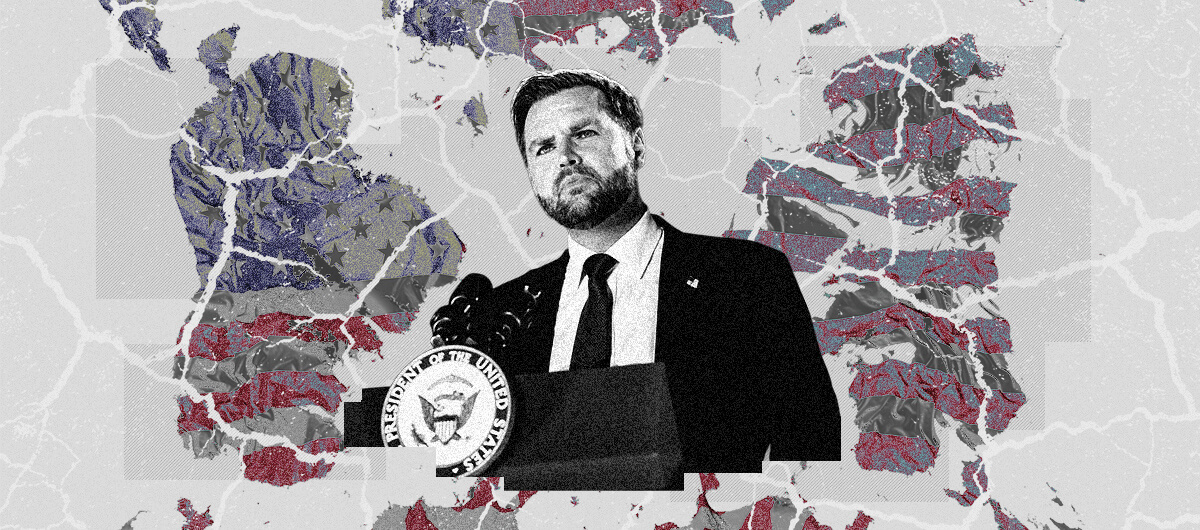
What Would a Vance Presidency Look Like?
For MAGA loyalists, Trump is a charismatic, even divine figure. But with the president’s questionable mental and physical health, the unpopular VP has been stealthily charting his succession plans, with a potentially more horrifying vision for the nation. Will he get in his own way?
This article was made possible because of the generous support of DAME members. We urgently need your help to keep publishing. Please join us for as little as $1.00 a month or make a one-time gift in any amount!
To millions of people, Donald Trump is something more than human. His shadow seems to stretch across the entirety of American life, transmuting and reshaping parts of our culture that were once considered immutable. This decade of Trumpism has changed the physical face of our country — and not just the White House East Wing, which has been reduced to a historical memory in the face of a towering new ballroom, though that’s plenty egregious. I’m talking about the core values upon which most Americans once agreed: Is a child born on U.S. soil an American? That we ask the question at all reveals how deeply our collective reality has shifted under MAGA rule.
There are, of course, a surging number of conservative Christians who believe Trump is a semi-divine figure anointed by God to bring about a great leveling, and whose faith in Christ has been supplanted by Trump worship. But there are also those millions of Americans who are Trump-skeptical or openly Trump-hostile, who see in his return to the White House a coming apocalypse for representative democracy. One need not be a believer in Trump’s cult of personality to acknowledge its terrifying scope and power.
One way or another, the era that bears his name will come to an end. Trump is now 79 years old. If he survives until the end of his term, he will be the oldest man ever to hold the job. His bruised hands, stiffened gait, perpetual drowsiness, fading memory, frequent MRIs, inscrutable and nonsensical gibberish articulated aloud and on Truth Social, and his scaled-back public schedule suggest that reaching 2029 will require more good fortune than even the perpetually lucky Trump has in reserve.
For months, Republican leaders have quietly shifted their eyes toward Vice-President JD Vance, who would succeed Trump in the event of his death and who remains the odds-on favorite to secure the party’s presidential nomination in 2028. A Yale Youth Poll released in early December found Vance commanding support from 51% of Republican voters aged 18-34. His opponents couldn’t even crack double digits.
If he somehow ends up in the Oval Office, either through Trump’s death or the GOP’s willing submission, MAGA ideology would undergo a sudden and drastic shift. Whether Vance can hold the already fragmenting MAGA coalition together in Trump’s absence is a question that has recently consumed the conversations of high-level Republicans across the nation.
There may be no more misunderstood character in the MAGA firmament than Vance. At 41, he is six years younger than Barack Obama was when he ascended to the presidency, and two years younger than John F. Kennedy. A political chameleon with no fixed values, even Vance’s former Senate colleagues struggle to pin down who he is or what he truly believes.
Vance himself seems to forget at times that he was once a different man, a proud Ivy Leaguer who penned an insightful and award-winning memoir of his life in rural Ohio, Hillbilly Elegy, that approached the plight of struggling Americans with clarity and compassion. The pre-MAGA Vance also seemed to understand the unique threat posed by then-candidate Donald Trump. In a scathing essay for The Atlantic published on July 4, 2016, Vance compared Trump’s appeal to “cultural heroin” and warned that Trump’s empty promises would leave struggling communities even worse off. He wrote:
“What Trump offers is an easy escape from the pain. To every complex problem, he promises a simple solution. He can bring jobs back simply by punishing offshoring companies into submission … He never offers details for how these plans will work, because he can’t. Trump’s promises are the needle in America’s collective vein.”
Nine years later, Vance is the man holding the MAGA needle and promising Americans that what they really need is an even stronger dose.
There are two things to consider when imagining what a Vance administration might look like: Form and Substance. The vice-president has been a quick study in imitating Trump’s mannerisms and brash boorishness, to the point where Vance now sounds more like the Donald Trump of 2016 than Trump does. He made headlines back in October after declaring that it was “totally acceptable” for Americans to want neighbors who “speak the same language” as them. The immigration system, Vance falsely claimed, had increased our cultural alienation by surrounding us with strangers.
“It is totally reasonable and acceptable for American citizens to look at their next-door neighbors and say, ‘I want to live next to people who I have something in common with. I don’t want to live next to four families of strangers,” Vance said. “The fact that we had an immigration system that actually promoted that division is a real, real disgrace.”
Vance’s wife Usha, née Chilukuri, grew up speaking Telugu, the native language of her Indian immigrant parents. It must have come as a shock that her own husband would likely have considered her parents unwelcome foreigners when they arrived in California in the 1980s. When Vance was just a self-described “hillbilly” attending Yale University, he even credited a young Usha Chilukuri for integrating him into an academic setting in which he felt like a foreigner.
“Usha was like my Yale spirit guide,” Vance wrote in Hillbilly Elegy. “She instinctively understood the questions I didn’t even know to ask, and she always encouraged me to seek opportunities that I didn’t know existed … In a place that always seemed a little foreign, Usha’s presence made me feel at home.”
Home appears to be a slippery concept for JD Vance these days.
He drew even more heat on November 14 when he dismissed the need to honor H-1B visas granted to skilled foreign workers, saying they were little more than foreign hangers-on. “We don’t need low-wage servants,” Vance said of the men and women, many with graduate degrees in technology and engineering, who had accepted job offers from some of the nation’s top companies. Instead, Vance suggested, American companies should hire blue-collar American workers — most of whom lack even basic qualifications for the jobs performed by H-1B visa recipients.
Vance’s adoption of MAGA rhetoric focuses almost exclusively on worsening the growing tension between native-born Americans and those who arrived in our country from abroad, legal or not. He is rarely heard discussing Trump’s economic policies, which have failed in such a spectacularly public fashion that even Republican voters now blame Team Trump for the country’s economic spiral. In fact, Vance seems to have nothing to say about actual policy at all. That’s one of the reasons he’s doing so well among Republican voters — instead of tying himself down to measurable policies, Vance acts as a messenger for MAGA supporters’ unquantifiable sense of racial grievance.
Unlike Trump, who takes his own race-baiting rhetoric as a reflection of the true state of American society, Vance’s own memoir and past public comments suggest he’s aware the racist dogwhistles he’s pumping out are lies. But it would appear that Vance also understands that assuming the external forms of Trump’s anti-immigrant rhetoric would allow him an almost unchecked hand to build a personal power base that differs drastically from the one Trump assembled for his own political campaigns. Nowhere is that clearer than in the constellation of Silicon Valley power players, investment bankers, and ambitious technocrats Vance keeps as a core part of his inner circle.
Where Trump was primarily interested in building a movement that glorified him personally, Vance’s goal is to turn MAGA from a rough-edged populist movement into a sophisticated intellectual and governing operation that can actually carry out its ideology. For that to happen, MAGA ideology and its leading luminaries will need to change. If Vance inherits Trump’s position, many Republican insiders expect a quick and brutal changing of the guard that will allow the VP to almost immediately begin reshaping the MAGA movement in his own image.
From billionaire tech investors and critics of democracy like Peter Thiel to Palantir CEO Alex Karp and “New Right” intellectuals like philosophers including Yoram Hazony and Curtis Yarvin, Vance’s version of MAGA promises to be unrecognizable from what came before. Vance has sanded down Trump’s brute-force populism into a political machine that unites his roots in the tech industry with an emergent right-wing intellectual movement that Trump never understood nor cared much about.
Vance understands that if Trump’s movement is to survive into the future, it will need to become Republican orthodoxy not just through the force of Trump’s personality cult, but by mimicking how the original conservative movement rose to power from the 1950s to the 1980s. That means translating Trump’s vague and often conflicting MAGA priorities into real policy ideas reinforced by conservative thinkers who carry intellectual weight among non-MAGA Republicans. He sees his role as shepherding the MAGA movement out of its awkward, temperamental teen years and into something resembling adulthood. Vance’s policies will still bear Trump’s bigoted and authoritarian DNA, but now they’ll be dressed in the suit and tie of Washington respectability.
A Vance administration likely would represent a “Trump administration on steroids” according to Boston University professor and political scholar Thomas Whalen, but the contours of its excesses would be sharply different from Trump’s populist ideas. For one, Vance’s administration would open the floodgates to the total capture of state power by America’s tech giants, many of whom the vice-president counts among his personal friends. If “the business of America is business,” as President Calvin Coolidge once said, under Vance its industry would be technology — a growing power base within the GOP that Vance has already begun integrating into the muscle and bone of Trump’s administration.
Palantir CEO Alex Karp, a Vance ally, has become the de facto contractor of choice to carry out Trump’s dirty work. In August, Palantir inked a $10 billion Pentagon contract to provide software and data “solutions” for the Army. It also developed a $30 million panopticon-like monitoring platform called ImmigrationOS that has become a favorite of ICE.
As Karp has grown closer to Vance and the Trump administration’s technocrats, his rhetoric has shifted sharply to the right. In a November 2025 letter to shareholders, Karp called for a “shared national experience — an embrace of common identity that by definition puts forward certain ideas, values, culture, and ways of living at the exclusion of others.” If that wasn’t clear enough for his readers, Karp took things a step further. “It is and was a mistake to casually proclaim the equality of all cultures and cultural values.” He called on his acolytes to “reject a vacant and neutered and hollow pluralism.” Pluralism, of course, is one of the bedrock principles of American democracy. To Karp, it’s little more than an obstacle to Palantir’s continued growth.
That’s a view espoused by another close Vance ally, Silicon Valley titan (and recent crusader against the antichrist) Peter Thiel. It was Thiel’s injection of $10 million into the 2022 Ohio Senate race that many experts credit with elevating Vance to victory, and the two have remained close ever since. Thiel has made a name for himself as one of the right’s leading critics of democracy, a system of government he considers incompatible with true freedom.
“I no longer believe freedom and democracy are compatible,” Thiel famously wrote in his 2009 essay “The Education of a Libertarian.” His anti-government, anti-democracy ideology runs deep not only within the clutch of right-wing tech bros who surround Vance, but increasingly in Vance’s own rhetoric about how the American system has failed. Any Vance administration would find Thiel in a dominant position, alongside other allies like investor Chris Buskirk, who views his role in Republican politics as redrafting the MAGA movement to be more politically effective. Sound familiar?
Vance’s presidency would unchain Silicon Valley from all regulation while allowing unprecedented intrusion into the personal data and personal lives of American citizens. Karp’s Palantir has proven the theory that such vast technologies can be developed and optimized, and Thiel’s deep pockets provide a ready source of funding for future efforts. Combine that love of techno-surveillance with Vance’s vehement misogyny, anti-immigrant, anti-abortion and anti-gay views (even as his greatest patron, Thiel, is gay) and it’s easy to imagine an America where marginalized communities live in the shadow of repressive moral laws enforced by round-the-clock, real-time surveillance. That may sound extreme, but the foundations of such a program are already being built at the Department of Homeland Security. Just ask Palantir, one of their largest contractors.
Vance also brings with him a host of prominent media voices from across the “New Right,” the buzzy new nickname for those odious hate peddlers driven out of the mainstream media due to their unrepentant bigotry. Chief among them is ousted Fox News host Tucker Carlson, who some Republicans have even floated as a possible running mate on Vance-led 2028 ticket. He’s also been floated as a possible White House Press Secretary, which would be final confirmation that we have in fact been living in Hell this entire time.
Carlson’s son Buckley joined Vance’s White House staff early in Trump’s second term, likely as payback for the huge effort Carlson expended to secure Vance as Trump’s running mate in 2024. Vance increasingly sounds like Carlson, too. Last month the vice-president sounded suspiciously like the inflammatory newsman when he claimed that antisemitism wasn’t a problem in the GOP the same week that Carlson hosted a fawning interview with America’s most prominent neo-Nazi and white supremacist, Nick Fuentes. Carlson might as well have passed Vance the talking points personally.
The biggest challenge facing a Vance administration is the staggering lack of perceived personal charisma from the candidate himself. Vance is no Donald Trump. He lacks both the stamina and the quick thinking rhetoric to anchor the hundreds of packed rallies as Trump held between 2016 and 2024. He also disdains populism, dismissing it as something that only appeals to dumb people, a fact he makes clear in Hillbilly Elegy and in his 2016 Atlantic essay. Vance is no populist, nor are the people with whom he’s surrounded himself. They represent not the apotheosis of the common man but his complete marginalization, politically and culturally. The Silicon Valley billionaires crafting a new surveillance state from the decks of their multi-story yachts have no use for Joe the Plumber or the crowds in Tunica, Mississippi.
Can the MAGA movement exist as something other than a populist movement of a disaffected and largely poor Republican base? Plenty of Republicans have their doubts. Vance’s attempts to turn MAGA into a kind of intellectually rarefied country club could easily create a deep split within the movement that results in two different and sharply opposed ideological wings. After all, as Trump so often says, hating the elites is a core part of his — and thus MAGA’s — core being. What Vance views as the classing-up of the movement, many of its followers view as rich-boy condescension.
The final and most unpredictable wild card is, of course, Trump. The Old Man of MAGA seems to be more disconnected from his movement than ever, but Trump is notoriously sensitive about the threat of being upstaged. Vance appears to be stealthily building his power base in the White House while still doggedly supporting his boss in every public standoff, conscious of the fact that moving too aggressively would invite the kind of fiery Trumpian denunciation that ends Republican political careers. And Trump has yet to fire a warning shot.
The American people are watching the sort of theatrical court politics normally confined to despotic regimes, where no talk about the dictator’s mortality is allowed until the moment he is either dead or ousted from power. Until that moment, the king will and must live forever, always in perfect health, always in command.
Despite Trump’s claims of imperial immortality, a growing number of Republicans are shifting uneasily behind the curtain. They see that all is not well in the White House. They know their great leader is aging and tired and apathetic about the job he began just under a year ago, and for which he’s still committed for three more long years. They silently contemplate a future without the endless shadow of Donald Trump looming over the American experience. JD Vance has spent months building the political and fundraising machinery to succeed a king who MAGA believes will never die. Convincing the Trumpists to accept him as one of their own will be an even more daunting task.
Before you go, we hope you’ll consider supporting DAME’s journalism.
Today, just tiny number of corporations and billionaire owners are in control the news we watch and read. That influence shapes our culture and our understanding of the world. But at DAME, we serve as a counterbalance by doing things differently. We’re reader funded, which means our only agenda is to serve our readers. No ads, no both sides, no false equivalencies, no billionaire interests. Just our mission to publish the information and reporting that help you navigate the most complex issues we face.
But to keep publishing, stay independent and paywall-free for all, we urgently need more support. During our Spring Membership drive, we hope you’ll join the community helping to build a more equitable media landscape with a monthly membership for as little as just $1.00 per month or a one-time gift in any amount.