


Trumpism
The Politics of Permanent Disaster
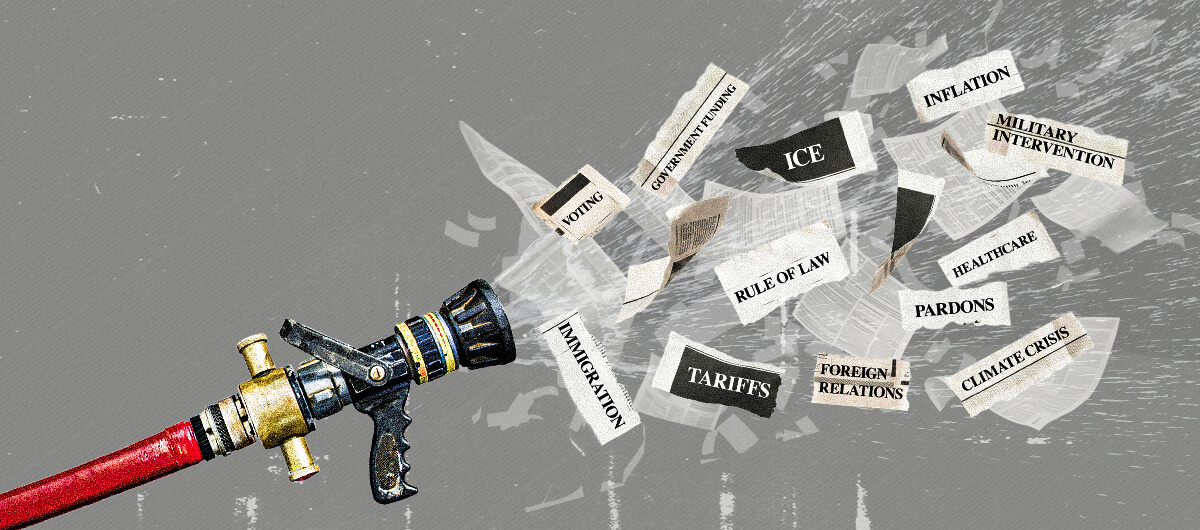
By flooding the system with one outrageous act after the other, the Trump administration sidelines Congress and exhausts the public. His power concentrates while the problems metastasize.
This article was made possible because of the generous support of DAME members. We urgently need your help to keep publishing. Please join us for as little as $1.00 a month or make a one-time gift in any amount!
“Bad governance, exactions, the cupidity and violence of the great, wars and brigandage, scarcity, misery and pestilence—to this is contemporary history nearly reduced in the eyes of the people. The feeling of general insecurity which was caused by the chronic form wars were apt to take, by the constant menace of the dangerous classes, by the mistrust of justice, was further aggravated by the obsession of the coming end of the world…” The Dutch historian Johan Huizinga wrote that in 1919 to describe the late Middle Ages, when Western Europe was beset by the Black Death, agricultural disasters and famine, and multiple, decades long wars. We call that a polycrisis, and it’s very similar to what we’re living through today. Unfortunately, the government meeting this moment is Donald Trump’s.
But as much as the Trump administration is confronting a polycrisis, it’s also knowingly cultivating one. Disaster is an opportunity for people to change things, to force through policies or reforms or cuts because there’s an emergency to justify them. It isn’t inherently bad: the New Deal was a product of the disaster that was the Great Depression, and it dramatically changed the role of the federal government. But Trump and his loyalists are not looking to solve any crises; instead, he weaponizes crisis, or the appearance of one, as a mode of governance, and then wields any gained power to achieve his political goals.
By now, the Trump playbook has been pretty clear: he finds an issue, declares that it is a crisis, and uses it to take unjust action. Take foreign trade. Trump claimed that the United States was facing an “emergency” with its balance of payments and that other countries were ripping off the U.S. This claim was farcical, either made in bad faith or with a third-grade understanding of what a trade deficit is. Having declared the emergency, Trump then imposed legally dubious tariffs on most countries in the world. Even if the tariffs are later overturned, rolling things back to normal is near impossible. Our former trading partners see us as unreliable, making future deals more difficult to broker.
The Trump administration has also engineered a daily constitutional crisis in order to continually undermine laws and political norms. The Trump administration has been “impounding” money authorized by Congress and refusing to spend it. It’s plainly illegal, both because of the 1974 Impoundment Act and the fundamental fact that Congress is responsible for spending. The attack on birthright citizenship, itself transparently unconstitutional, has nevertheless gone forward via executive order. It’s no different than when he declared fentanyl a “weapon of mass destruction” and used it as a justification for intervention in Venezuela. While many Trump policies wind up in court, they’re an imperfect way of halting this administration. Between tying them up in appeals and the prospect of a hostile Supreme Court, the reality is that most Trump policies remain on the books.
Disaster and crisis give the appearance of dynamism and efficiency, a hallmark of fascism: they have to look busy, and it plays well with a MAGA base that demands action even if that action is disastrous in the long term. But while they make the executive branch look “efficient”, it sidelines Congress. Congress has had no role in solving any of these crises; at present, Congress can’t even guarantee that the money it allocates for spending won’t be illegally held back by the Trump administration. It seems to have no role in solving any of the real or imagined emergencies that the United States is facing. If you’re a liberal, it can’t seem to stand up to Trump, and if you’re a conservative, who needs Congress at all? The end result is the same for both sides: Donald Trump becomes the only person with any real political power, and nothing else can get done.
Moreover, living under this regime’s political whiplash encourages learned helplessness. A state of constant emergency isn’t psychologically tenable, and people will eventually adapt to this new reality. With that comes something truly corrosive: surrender. Without a clear means of taking action, people give up. Even when independent voters or some MAGA voters turn on Trump as the economy worsens, health care becomes inaccessible, and the housing market falls apart, they’re not going to feel like they have any recourse. Congress won’t seem to have a role to play, and contrary to what Trump wants to project, presidents don’t have much control over the economy. Responsibility for problems slips away, and they become something that nobody can solve.
The constant overload also makes it difficult to ever actually accomplish anything of substance. Flitting from emergency to emergency is a good way to wear down critics and “flood the zone with shit” in the parlance of Steve Bannon, because there are no real solutions that ever come out of it. Take the latest political buzzword: “affordability”. Trump wants to tackle housing because Americans are being priced out of owning homes and criticisms over affordability actually seem to touch a nerve with him, but he also wants housing prices to keep going up. To accomplish this, he’s attacking the Federal Reserve in the hope that it will be responsive to lowering interest rates, a move which will only further destabilize markets and likely lead to inflation if interest rates are kept artificially low. All of these objectives are in tension with each other and only exacerbate a crisis that Trump purports to solve.
For Trump, crisis is also a tool for compliance. He’s willing to withhold federal support for natural disasters unless there’s a quid pro quo. He’s been locked in a battle with California over wildfire recovery funds amid a threat of withholding them, and in the latest development, he’s trying to enable homeowners to bypass state and local safety regulations as they rebuild. As our various crises continue to batter the country, Trump will clearly use them as a means of gaining leverage, or simply punishing those who he feels have been disloyal to him.
But it also goes beyond using crises to punish enemies and reward allies. The administration wants to rewrite the responsibility of the federal government in day-to-day life. FEMA has slow-rolled the release of disaster relief funds even in reliably Republican states like South Carolina and Texas. The expectation is that states themselves will take the lead on this issue going forward while the federal government scales back its commitment; in mid-2025, Trump’s goal was to eliminate the agency altogether because it was allegedly being run so badly that it was on the verge of collapse. In other areas, especially public health, they’re trying to kill institutions by subjecting them to death from a thousand cuts. The Centers for Disease Control and Prevention (CDC) is a perfect example: over the course of 2025, it lost anywhere between a quarter to a third of its staff. Even where programs weren’t directly eliminated, they’ve been dramatically weakened, perhaps to the point that they won’t be able to effectively carry out their mandate. Reviewers at the Food and Drug Administration (FDA) were let go, making it harder for them to keep up with the pace of work or to effectively supervise approvals. People will continue leaving these jobs simply because working at them has become too difficult. At that point, it becomes easier to justify cutting them altogether, or letting them molder.
Finally, a crisis creates opportunities for corruption because there’s a demand for rapid action with little oversight. For Trump and those around him, that is very much an objective: Crises are easy opportunities to make money. The gutting of inspectors general throughout the federal government, natural disaster funding, foreign intervention, and more allow for big infrastructure projects like Project Stargate to become an easy vehicle for Trump allies to make money.
How can Democrats break out of this? Trump’s weaponization of polycrisis doesn’t change the fact that it actually exists, and good politicians need to campaign on real solutions to our various crises and provide alternatives to Trump. Democrats need to start thinking in terms of a New Deal, and I don’t just mean economically (though I’d love to see them embrace that). They need to embrace bold, big plans and be willing to pursue lots of things all at once. This also means abandoning a fear of being on the wrong side of public opinion. Democratic leaders are all too often wary about taking stands on issues for fear that it might blow back on them, and in so doing they forget that they can try and shape public opinion too. They’re trying to do so with affordability, but that’s just one approach. They need to pursue it broadly. They need to define and emphasize the crises, and do something they haven’t done at a leadership level: truly challenge Trump, and put him on the defensive.
Before you go, we hope you’ll consider supporting DAME’s journalism.
Today, just tiny number of corporations and billionaire owners are in control the news we watch and read. That influence shapes our culture and our understanding of the world. But at DAME, we serve as a counterbalance by doing things differently. We’re reader funded, which means our only agenda is to serve our readers. No ads, no both sides, no false equivalencies, no billionaire interests. Just our mission to publish the information and reporting that help you navigate the most complex issues we face.
But to keep publishing, stay independent and paywall-free for all, we urgently need more support. During our Spring Membership drive, we hope you’ll join the community helping to build a more equitable media landscape with a monthly membership for as little as just $1.00 per month or a one-time gift in any amount.