


CaseyMartin/Shutterstock
Trumpism
CaseyMartin/Shutterstock
How Trump Turned the Presidency Into a Profit Engine
‘State capture’ systematically rewires government so public power feeds private wealth, and it’s an authoritarian framework undoing American democracy.
This article was made possible because of the generous support of DAME members. We urgently need your help to keep publishing. Will you contribute just $5 a month to support our journalism?
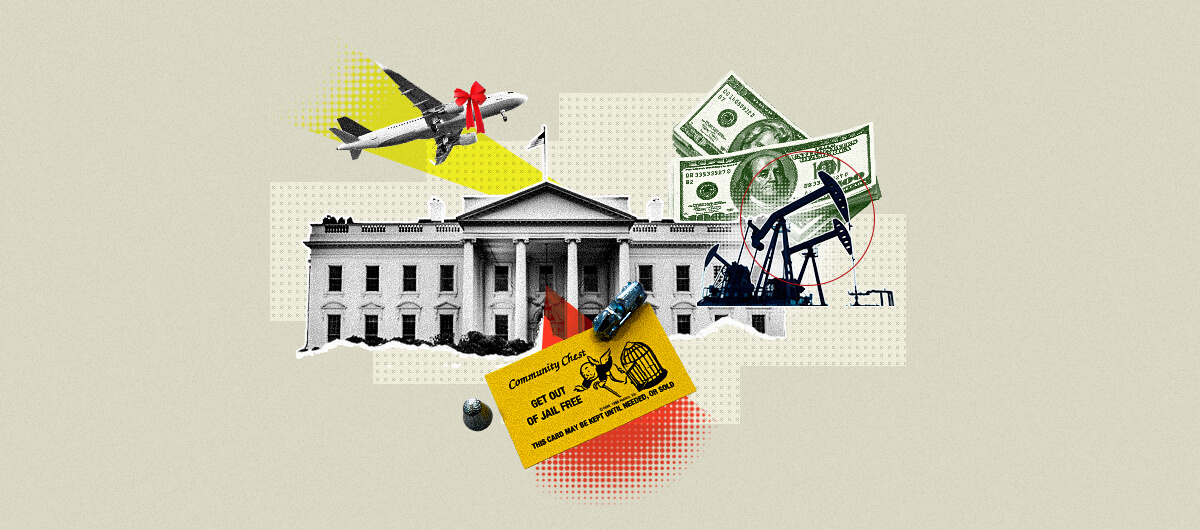
Naked corruption has emerged as one of the Trump administration’s major hallmarks, and all signs suggest it is about to intensify. There’s the obscenity of gifts like the Qatari jet that Trump received as a new Air Force One, but that is but a symbol amid the more systematic grift weaving its way through every channel of this administration.
In just one year, Donald Trump’s wealth has grown by $3 billion, largely through cryptocurrency — an industry he regulates and has so far allegedly manipulated for his own benefit. A cottage industry of lobbyists funnel pardon requests to Trump; the going rate for a pardon is supposedly $1 million, and Trump issues them on a rolling basis for friends and supporters. The president has a bank account in Qatar that holds proceeds from the sale of Venezuelan oil. Private prison companies like Geo Group are making a fortune off the number of people being imprisoned and deported by ICE by building camps and detention centers. Starlink, Elon Musk’s satellite and internet provider, has suddenly muscled its way into numerous foreign markets because the Trump administration exerts pressure on their governments. Under Trump, the U.S. government now has stakes in multiple different companies, including Intel. Trump’s pressure campaign to annex Greenland would be a huge giveaway to mining companies and defense contractors (that it would be hugely inefficient and expensive is only a problem for us, Europe, and the people of Greenland).
There’s a term for this: state capture.
State capture is a framework of corruption where private businesses and individuals find ways to redirect public resources for their own benefit. It’s not the kind of low-grade embezzlement or outright theft that you might find in other systems, though it can involve theft. Laws are rewritten or restructured to protect a few people, often through lobbying or personal relationships. Enforcement mechanisms and oversight are systematically dismantled. Fundamentally, it’s the creation of a closed loop where public tax dollars ultimately find their way into the hands of a few through preferential contracts or seemingly legal business connections.
If you want to understand state capture, looking at South Africa is a great case study. State capture has been highly visible in South Africa since the end of apartheid. Even with the end of that racist system, enormous wealth inequities remained between white and Black South Africans, and government became one of the most effective ways to make a fortune. The apartheid years also encouraged secrecy in government, and that lack of oversight and accountability easily breeds corruption.
This happened most infamously with the Guptas, a family of Indian immigrants who came to South Africa in the 1990s. They built an enormous business empire that profited from a close relationship with members of the ruling ANC party. In exchange for supporting members of the party, they received, skimmed, or stole billions of rands through inflated contracts and control over state-run companies such as Transnet. The Guptas influenced the appointment of cabinet ministers, all from behind the scenes, and at their peak of influence they enjoyed a close relationship with former Prime Minister Jacob Zuma.
There were plenty of other examples, often more local ones. Nelson Mandela Bay Municipality, part of the city of Port Elizabeth and home to more than a million people, was the subject of an investigation that found that members of the local ANC government were colluding with criminal gangs and in some cases carrying out murders to maintain their influence over the city. Public funds from transportation and housing (all of which were meant to support the poorest and most vulnerable people) were being skimmed. Even after this came to light, fixing it has proved to be difficult: The city has had seven mayors since 2016, and much of the municipal administration is vacant.
We’re living through state capture right now. The United States had a number of the preconditions in place: The flood of unlimited “dark money” into political campaigns allows for all kinds of unseen influence on the political process. Government inspectors general are being dismissed or starved of funds, making it more difficult to carry out oversight. The Foreign Corrupt Practices Act has been weakened, making it easier for Americans to pay bribes overseas and face no consequences at home.
State capture creates a devastating feedback loop of corruption. Silicon Valley and Wall Street elites can ensure that they can use the federal government to profit, crush competitors, and dominate the market. That makes government one of the best ways for people to become wealthy, but you can only expect to succeed in government if you’re willing to abet corruption yourself. It creates a culture of routine, grassroots corruption. If you’re a government employee, you have to find things to steal because somebody above you is already doing it. There’s nobody you can go to for accountability, and doing so exposes yourself to a great deal of risk.
It also cements authoritarian power. Viktor Orban, the far-right president of Hungary and a close ally of Trump and his allies, has systematically remade Hungary’s politics through state capture. Indeed, there’s growing evidence that conservatives see Orban as a model to follow for the United States. The ruling Fidesz party controls state-run media and licensing, enabling them to censor political discourse. Anti-corruption laws are selectively enforced which sends a very clear message: play by the party’s rules, and you’ll be left alone. And of course, Orban has used this system as a giant patronage network to ensure the loyalty of people who fear being cut out, especially after years of stealing public funds.
Moreover, it depresses the overall economy. While a few wealthy people and well-connected businesses will be able to vacuum up money, everybody else languishes. Companies have no incentive to be innovative if they’re in good with the government, and competitors face long odds at even running viable businesses. If you’re not politically well-connected and you can leave, it’s probably in your interest to do so, which in turn encourages brain drain. Public infrastructure decays; roughly a quarter of the publicly built houses in Nelson Mandela Bay in 2017 simply didn’t exist, but the government had been billed for their construction. In Hungary, Orban’s economic policies have only weakened the country. Ironically, it is heavily dependent on funds from the EU despite Orban’s open dislike of Brussels.
So, what can we do about it? It’s going to be a difficult road out of this one. In South Africa, state capture was blunted, reversed, or held back by a combination of different civil society forces: independent media, a strong judiciary that vigorously enforced the country’s post-apartheid constitution, and very active protest movements that had been forged first against the apartheid government and then in movements like the Treatment Action Campaign, which fought for access to HIV/AIDS drugs.
Despite the assault on mainstream media, there is still a functioning independent press in this country, and despite the fact that the Supreme Court is compromised, we still have a judiciary that can obstruct and throw grit in the gears. What people need is going to be protection. Even if threats against whistleblowers, journalists, and activists don’t escalate to violence, they’re going to face a mountain of lawsuits. Many of them will be frivolous, but that’s an easy tactic at hand for rich people trying to evade consequences. If we want to protect democracy and reverse state capture, the organs of civil society need to find ways to fund legal protection and the work of those holding the government accountable. Fund independent media and fund people facing lawsuits.
Fighting back also has to start at the grassroots level. Where things are right now, there’s no hope of directly challenging Starlink or cutting off federal funds to Elon Musk’s various businesses. But finding local ways to fight back will build momentum, keep people off the sidelines, and start to eat into the bottom lines of various Trump supporters. Private businesses are never going to do the right thing on their own. This means blocking data center construction, for example, or finding ways to slow or stop permitting for private prison contractors. Use permitting, use public hearings, anything that will raise bad press for companies that benefit from a connection to Trump.
Moreover, Democrats can make an issue of this and run on it. The reality is that billionaires amassing obscene amounts of wealth is unpopular, especially as the economy worsens. There’s a critical window that we’re still in where people can meaningfully campaign off of anti-corruption, and it’s vital to do so now. It means being more vocally anti-corporate than Democrats have been in the past, and it means occasionally being cringe. We have to talk about civic virtue — loudly. Once in office, investigations into the extent of state capture need to begin immediately: South Africa’s Zondo Commission worked from 2018 until 2022 unraveling the extent of state capture. But all of this hinges on the Democrats being in power and capitalizing on this issue, using their position for now (and this year’s midterms) to hammer the message home: these people are corrupt, and they’re stealing from us.
And then, once Democrats are back in power (and have faced the reality that bold action is necessary) we need to reform our system to prevent this. We need to talk seriously about a constitutional convention, even knowing that many Republican-led states would at this moment shoot down anything coming from Democrats. Why? We need to create momentum for what comes next and to make clear that going back to “normal,” i.e., before Trump is not going to be possible.
These changes will need to be far-reaching, because part of the problem is that a broad swathe of Congress (namely, the Republican Party) has simply allowed the Executive Branch to act unilaterally and gut the federal bureaucracy without any pushback. It may be that regulators, watchdogs, and inspectors more properly belong in the legislative or judicial branches and protected statutorily so that they can’t simply be dismissed by decree. They need to demand changes to the Emoluments Clause, as it has clearly been insufficient to stop corruption in the White House. The Executive Branch needs to be constrained again, possibly by transferring control over executive agencies to Congress. Clawing our way back from this will be difficult, but if we don’t collectively run on an ambitious vision for change we will simply be at risk of another Trump in our future.
Before you go, we hope you’ll consider supporting DAME’s journalism.
Today, just tiny number of corporations and billionaire owners are in control the news we watch and read. That influence shapes our culture and our understanding of the world. But at DAME, we serve as a counterbalance by doing things differently. We’re reader funded, which means our only agenda is to serve our readers. No both sides, no false equivalencies, no billionaire interests. Just our mission to publish the information and reporting that help you navigate the most complex issues we face.
But to keep publishing, stay independent and paywall free for all, we urgently need more support. During our Spring Membership drive, we hope you’ll join the community helping to build a more equitable media landscape with a monthly membership of just $5.00 per month or one-time gift in any amount.