


Explain This
The Big Business of War for Oil
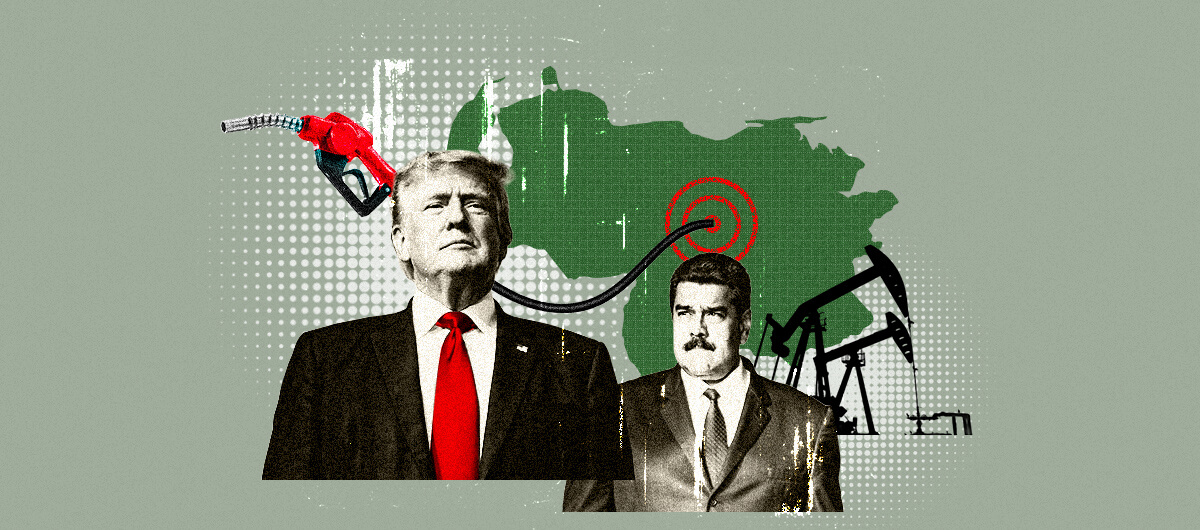
The Trump administration’s criminal attack on Venezuela and abduction of the Maduros surprised everyone — except major oil companies. This isn’t the first time U.S. military deployment was motivated by corporate interests.
This article was made possible because of the generous support of DAME members. We urgently need your help to keep publishing. Will you contribute just $5 a month to support our journalism?
On Saturday, January 3, 2026, President Nicolás Maduro of Venezuela was seized by U.S. troops in a raid on his safe house in Caracas. The exact number of deaths is unknown, but estimated to be between 40 and 80, a mix of Venezuelan and Cuban soldiers along with some civilians. Congress had no inkling that “Operation Absolute Resolve” was about to unfold — they learned about it along with the rest of us. Though we quickly learned that Trump made sure major oil companies were apprised of it ahead of time. He’s now promising more of the same, claiming that Colombia’s President Gustavo Petro is a cocaine kingpin and that he could capture him as well. Homeland Security Adviser Stephen Miller is now threatening the same for Greenland.
There is a precedent for this. In his book War Is a Racket, Major General Smedley Butler, a veteran U.S. Marine, recounted his 33 years and four months in active military service:
“I spent most of my time as a high-class muscle man for Big Business, for Wall Street and the bankers. In short, I was a racketeer, a gangster for capitalism … I helped make Haiti and Cuba a decent place for the National City Bank boys to collect revenues … Looking back on it, I might have given Al Capone a few hints. The best he could do was to operate his racket in three districts. I operated on three continents.”
Major General Butler was writing those words in 1934, but they could just as easily be applied to what President Trump has in store for the Western Hemisphere: gangster capitalism and cronyism.
Even by the standards of the Trump administration’s dangerous foreign policy, the kidnapping of Venezuela’s president Nicolás Maduro is a serious escalation. It’s a war crime: There’s no legal international justification for seizing a foreign head of state, even if you accept the bogus premise that Maduro is a narco trafficker who is the mastermind behind the fentanyl crisis. It wrecks the UN Charter, which prohibits members from attacking other states to seize their territory or limit their political independence. In effect, the United States has smashed to bits the remnants of the international legal system, painstakingly built up after two devastating world wars.
All of this was telegraphed in the administration’s 2025 National Security Strategy, which asserted that the United States needs to restore its preeminence in the Western Hemisphere. Translation? The United States will act as the regional power, and Venezuela is step one of that plan. Oil is a part of this, as Trump has repeatedly said, and to him it might even be the primary component — but for those around him, it’s a reordering of how foreign policy is supposed to function: The strong will do as they wish, and the weak will endure what they can (to paraphrase Thucydides).
But this might be looking too far into the future. What can we expect for Venezuela? What will the occupation look like? The Trump administration doesn’t seem to have much of a clue. For all of their rhetoric about U.S. preeminence, they seem to be light on details. Vice-President J.D. Vance argued that this was like a police action and not an invasion, meaning that it will be limited. Trump seemingly contradicts this by saying that it might be about regime change, saying in an interview with The Atlantic, “You know, rebuilding there and regime change, anything you want to call it, is better than what you have right now.” Secretary of State Rubio says we won’t be running the country; Trump says we will.
But the plan at present is an odd one. Maduro and his wife were seized and brought to the United States for trial, while everybody else in the Venezuelan government (so far) is still in place. Delcy Rodriguez, Maduro’s Vice-President, will become the interim president. There’s no timeline for an election (despite the fact that Trump and others have claimed that Maduro’s an illegitimate leader). They just want U.S. oil companies to be allowed back in and for any Cubans and Iranians who are present to be kicked out.
Trump, Vance, Rubio, and Miller might hope that by keeping American troops out for now that they can keep this palatable to the MAGA coalition. Republicans around Trump are stating again and again that American troops won’t be a part of this, presumably to keep away those fears of another quagmire like Iraq or Afghanistan. Working with Delcy Rodríguez might seem like a way to do this with minimal fuss for the U.S., but it puts her in an impossible position: She has to be seen publicly cooperating with a foreign government that is very transparent about taking the country’s natural resources, all amid the country’s economic crisis that will likely be worsened by the Trump administration siphoning off the country’s oil revenues. The country’s opposition leader Maria Machado has just been sidelined by Trump — reportedly in part because he’s mad that she didn’t give him the Nobel Prize she won last year — but still opposes the ruling party. This is not a recipe for stability.
What happens if Rodríguez is ousted or loses control of the country, and her successors don’t want to continue accommodating Washington? Will the Trump administration tolerate a black eye like that? Can we keep boots off the ground if riots in Caracas force the government out of power, or threaten American investments? Trump is practically haranguing oil companies into returning to the country; if their business is threatened again, what will we do?
In terms of likely historical models, we have plenty to pick from in our own history, namely earlier U.S. interventions in Latin America and the Caribbean. We’ve tried this type of gangster capitalism before. The Second Iraq War is not a useful model to follow for this, but the U.S. occupations and incursions into Haiti, Nicaragua, Cuba, Panama, and elsewhere are. These occupations might have seemed small; many Americans at the time were likely only dimly aware of them. But they had far-reaching consequences that lasted for decades.
Nicaragua’s an excellent example of what a U.S. “occupation” of Venezuela might look like. The country was of interest to American presidents because of the possibility of building a canal there that could join the Atlantic and Pacific Oceans; it also received a great deal of American capital. Ongoing clashes between the country’s Liberal and Conservative Parties, fueled in part by the ties of the Conservative Party to the United States led to the U.S. Marines being deployed to “keep the peace.” They sided with the Conservative Party and remained off-and-on in the country for the next 20 years.
The United States dominated Nicaragua after this. Financiers in New York chartered a Nicaraguan national bank that they controlled; they also took control of the country’s railroad system. Nicaraguan customs revenue (a major source of the government’s funding) was collected by an American to pay down the country’s debt. The United States controlled the country’s budget directly after 1916. For Washington, this was a successful arrangement. Nicaragua paid down its debts, but for Nicaragua it meant economic stagnation. The government couldn’t invest in anything except paying down its debt, and its economy became ever more dependent on growing coffee. Only a hundred U.S. Marines remained behind, but the threat and implication was clear: More would arrive if trouble arose, which is exactly what happened. Meanwhile they worked to train the country’s new National Guard, which in theory was supposed to be an impartial armed force that neither side would fear.
In 1926, fighting broke out again between the Liberals and Conservatives, and this time the Marines spent several years engaged in a protracted guerilla war. A segment of the Liberals led by Augusto Cesar Sandino refused to accept a peace treaty and kept fighting. Sandino asked his men to lay down their arms after the Marines withdrew in 1933, but he was subsequently lured into an ambush by the Nicaraguan National Guard in 1934 and assassinated. The architect of Sandino’s assassination, Anastasio Somoza Garcia, seized power two years later, and his family controlled the country for the next four and a half decades. When they were finally removed from power in 1979 by the left-wing Sandinistas (named for Sandino), the United States in turn spent a decade funding a right-wing militia, the Contras, in a civil war that ultimately killed 40,000 people and created a refugee crisis.
Small interventions can spiral out of control in catastrophic ways; “contained” occupations can still wreak disproportionate havoc on a smaller country. A few hundred marines in 1912 kept coming back, and fighting, and training, and once Washington had decided that it couldn’t afford to lose control of Nicaragua the bloodshed took on horrifying proportions.
Democrats need to abandon the position that they need to be “briefed” on what happened in Venezuela and stop clarifying that Maduro was a dictator because the whole premise of the intervention is farcical. There’s no justification for this; it’s transparently illegal, and there’s no reason to expect that the administration will do anything but lie in order to cover for it. There’s no reason to be an institutionalist or follow past norms; elected Democrats are free to condemn this here and now with no qualification and no waiting period.
Before you go, we hope you’ll consider supporting DAME’s journalism.
Today, just tiny number of corporations and billionaire owners are in control the news we watch and read. That influence shapes our culture and our understanding of the world. But at DAME, we serve as a counterbalance by doing things differently. We’re reader funded, which means our only agenda is to serve our readers. No both sides, no false equivalencies, no billionaire interests. Just our mission to publish the information and reporting that help you navigate the most complex issues we face.
But to keep publishing, stay independent and paywall free for all, we urgently need more support. During our Spring Membership drive, we hope you’ll join the community helping to build a more equitable media landscape with a monthly membership of just $5.00 per month or one-time gift in any amount.