


Explain This
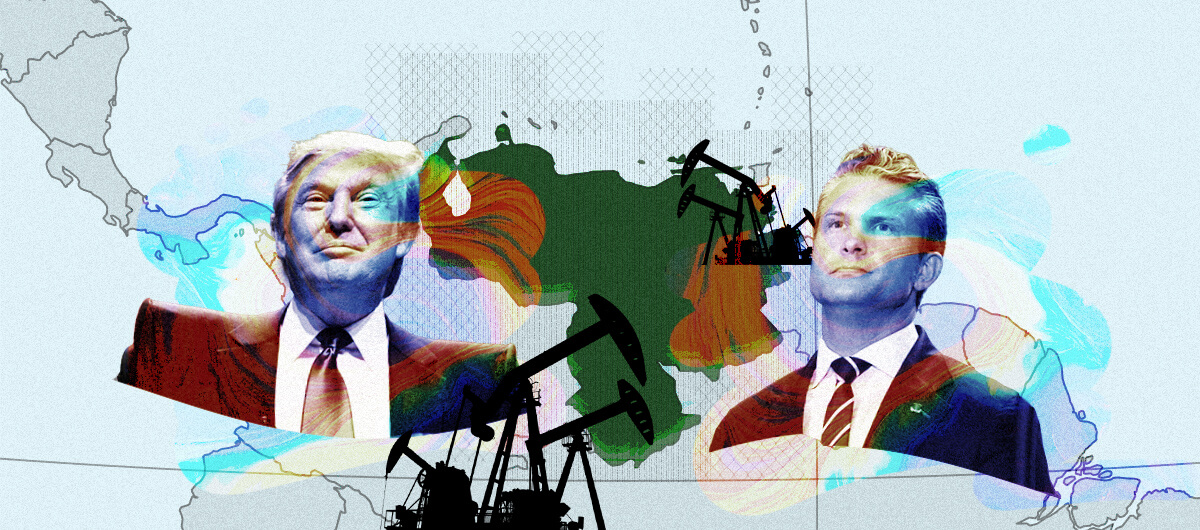
What Is Behind Trump’s Attacks on Venezuela?
The administration claims it’s targeting “narcotraffickers” with deadly strikes on Venezuelan boats, a justification that falls apart under Trump’s pardon of Honduras’s cocaine-trafficking ex-president. These vicious acts of aggression echo a long U.S. tradition of strong-arming Latin America.
This article was made possible because of the generous support of DAME members. We urgently need your help to keep publishing. Will you contribute just $5 a month to support our journalism?
The polycrisis that is the Trump administration can be difficult to fully keep track of: As Steve Bannon once said, the goal is to “flood the zone with shit” and paralyze us from being able to respond to everything. But buried amid the PR exercises and the deliberately offensive speeches are very real issues that could explode into disasters. One of the real crises being engineered by the administration is taking place in Venezuela.
Trump has had Venezuela in his crosshairs from the moment he took office, initially by working to deport Venezuelan migrants en masse and trying to persuade Americans that most of them are members of gangs like Tren de Araguas. Now the Trump administration’s attacks have escalated to military strikes against manned boats off the coast of the South American country and in the Caribbean. Trump alleges the people on the boats are actually narcotraffickers to justify the outrageous attacks, but there is no supporting evidence for this claim. Narcotraffickers aren’t armed combatants and don’t pose a direct threat that justifies the use of violence. Moreover, one of Defense Secretary Pete Hegseth’s orders was to “kill everybody” on a boat and sent a second strike to kill two survivors in the wreckage. This is illegal under international law.
There are worrying signs that this is just the start, too. He’s promising strikes on land. Moreover, Trump is publicly saying he will sign off on CIA operations to topple the Maduro government — most recently, he’s ordered Venezuela’s airspace closed. The fact that the Trump administration gutted the legal arm of the military by firing and purging personnel in the Judge Advocate General’s (JAG) office is doubly troublesome: They want to carry out war crimes and get away with it.
It may be that Trump, or his key advisor Stephen Miller, have no serious intention of going to war or installing a regime change in Venezuela and that it’s merely a convenient distraction from the Epstein Files. There’s certainly no popular support for war with Venezuela right now. And clearly it has nothing to do with stopping drug trafficking, because on Monday evening, Trump pardoned Juan Orlando Hernández, the Honduras’ ex-president at the center of “one of the largest and most violent drug-trafficking conspiracies in the world,” who’d been convicted for trying to smuggle 4oo tons of cocaine into the U.S., leading to his imminent release from prison. It all has the feeling of a cruel, bloody sideshow — it’s possible that the administration is just murdering people for content now.
For your Christmas wish list… pic.twitter.com/pLXzg20SaL
— Pete Hegseth (@PeteHegseth) December 1, 2025
But it’s also likely that they’re interested in the country’s large petroleum reserves because they could use them to drive down gas prices at home (or just steal what they can, in Trumpian fashion). Or, perhaps Trump and those around him, see it as yet another way to Make America Great Again by reviving an old tradition of military involvement and action in Latin America. More than a century ago, a crisis in Venezuela inaugurated a new era of interventionism and bullying by the United States.
Throughout most of the 19th century, the United States had relatively little involvement in Latin America. The Monroe Doctrine announced that it would be the policy of the United States to block European countries from interfering in newly independent Latin American states, but its own involvement with these states was minimal. Great Britain was the largest trading power and investor in the region.
Americans did have annexationist interest in the region. Thomas Jefferson continually expressed interest in Cuba during his lifetime, and pro-slavery filibusters like William Walker occasionally tried to found pro-slavery colonies for themselves in places like Nicaragua, but the U.S. government largely avoided interference. Even when it tried, the country had a weak navy for most of the century: In 1885, a brief war scare with Chile over U.S. support for Panamanian rebels was tempered by the fact that Chile’s navy would have devastated the outdated American ships with ease.
That started to change by the end of the century. Victory over Spain in 1898 left the U.S. with colonies in Puerto Rico and the Philippines, and de facto control over Cuba. President Theodore Roosevelt was interested in a muscular world presence and in seeing the U.S. act like a world power (meaning, compete directly with European imperialism). In 1902, Venezuela found itself in trouble with Germany, Italy, and England because the country’s government stopped making payments on its foreign debt and was placed under a naval blockade. Those countries received money in international arbitration, which Roosevelt and others worried would weaken U.S. preeminence in the Western Hemisphere.
The result was the Roosevelt Corollary. Theodore Roosevelt explained it to Congress in 1904, saying that “If a nation shows that it knows how to act with reasonable efficiency and decency in social and political matters, if it keeps order and pays its obligations, it need fear no interference from the United States. Chronic wrongdoing, or an impotence which results in a general loosening of the ties of civilized society, may in America, as elsewhere, ultimately require intervention …” It inverted the whole Monroe Doctrine, promising that the United States would intervene whenever a country was engaged in unspecified “wrongdoing.”
Roosevelt expected countries to stop borrowing heavily, to not pursue aggressive social transformation, and to be receptive to American business investment. Anything too revolutionary was suspect. It was a moral framework for international relations, and the results were repeated interventions and occupations of different countries. U.S. troops went to Honduras in 1907, 1911, 1919, 1924, and 1925. When Black Cubans protested against racial discrimination in 1912 and tried to organize a political movement, U.S. marines quashed it; they returned five years later and stayed until 1922. The United States occupied Nicaragua in 1912 and didn’t leave until 1933; they occupied Haiti in 1915 and left in 1934. These were not peaceful occupations, either. Several thousand Haitians died fighting the United States, and more still died after being sentenced to hard labor.
Theodore’s cousin President Franklin D. Roosevelt declared an end to the Roosevelt Corollary in 1933 with the Good Neighbor Policy, but it was more of an interlude. The United States refused to tolerate leftist governments during the Cold War, and the CIA worked with conservative elements in many countries to topple their governments, beginning with Guatemala in 1954. U.S. troops no longer did the dirty work (with the brief exception of Grenada in 1983 and Panama in 1989), but the results were incredibly bloody: 3,000 dead in Chile, 30,000 dead in Argentina, another 30,000 in Nicaragua, and on it went.
This seems to be what Trump wants: a modern Trump Corollary that all at once is an easy way to project strength by bullying other countries while sending a warning to neighboring governments about what he will tolerate.
So, how is Trump applying it? Look at his allies in South and Central America: Javier Milei of Argentina and Nayib Bukele of El Salvador. They conduct themselves like Trump: They pursue dramatic right-wing policies, they trample all over human rights, and above all, they run states that mostly steal from their citizens for the benefit of a few elites. Going after Venezuela is a statement about what kinds of governments they will tolerate in this hemisphere. None of this is a defense of the Maduro government; we can just be sure that anybody Trump would replace Maduro with would only make the lives of Venezuelans worse. Maria Machado, the current leader of the Venezuelan opposition — and, inexplicably, the winner of this year’s Nobel Peace Prize — has endorsed Trump’s strikes on boats.
What can we do? If you’re lucky enough to live abroad, encourage your elected leaders to stop sharing information with the U.S. government. Ending military cooperation is vitally important because for all intents and purposes, this country is a rogue state with a dangerous agenda. International isolation is the best thing for the United States.
For those of us here, the first step is to publicize these killings for what they are: war crimes. There’s absolutely no legal basis for these killings. They aren’t combatants even if you accepted the premise that they were drug traffickers. And even if they were combatants, murdering them without giving them a chance to surrender would still constitute a war crime. There’s no veneer of decency or justification that they can hide behind. Americans need to understand, and the press needs to underline the fact that these strikes are a crime — and when we’re finally on the other side of this, we need a guarantee that this administration will be held accountable by putting them on trial. Exposing the details of these killings conversely is a moral good, and encouraging whistleblowers to come forward and testify as to what’s happening behind the scenes is necessary.
More fundamentally, the United States needs to build a meaningful peace movement. Alongside a No Kings movement, we need a No Wars movement. Earlier anti-war movements have struggled to stop momentum because they only start up once the buildup to war is in motion. By then, it’s almost always too late, even in cases like the second Iraq War where millions of people turned out into the streets.
Arguably one of the more successful examples is lesser-known, perhaps because it was successful and there weren’t U.S. boots on the ground or weapons rolling into the country: Angola, in Southern Africa. The point at which it became independent in 1975 was also marked by a civil war, with the communist MPLA initially in a dominant position. American activists, fearing another Vietnam so soon after that war ended, mobilized frantically to block aid via the Clark Amendment. The war raged on, but the Ford administration could not put its hand on the scales.
We need to be anticipatory that same way and not tolerate a business-as-usual politics like we have the past two decades that normalized drone strikes elsewhere in the world. Lobbying Congress to block military aid or support to figures that Trump wants to support is critical, whether that’s established figures like Bukele or aspiring leaders like Machado. Outside of the legislature, negative publicity and attention aimed at military bases, weapons suppliers, and other components of our war machine need to be constant. Republicans are visibly nervous about this and uncomfortable, even going so far as to claim that any strikes against helpless people would be a war crime. They haven’t fallen into lockstep on this issue yet, and enough pressure could turn them against Trump and Hegseth, leaving the administration with a conspicuous black eye.
Before you go, we hope you’ll consider supporting DAME’s journalism.
Today, just tiny number of corporations and billionaire owners are in control the news we watch and read. That influence shapes our culture and our understanding of the world. But at DAME, we serve as a counterbalance by doing things differently. We’re reader funded, which means our only agenda is to serve our readers. No both sides, no false equivalencies, no billionaire interests. Just our mission to publish the information and reporting that help you navigate the most complex issues we face.
But to keep publishing, stay independent and paywall free for all, we urgently need more support. During our Spring Membership drive, we hope you’ll join the community helping to build a more equitable media landscape with a monthly membership of just $5.00 per month or one-time gift in any amount.