
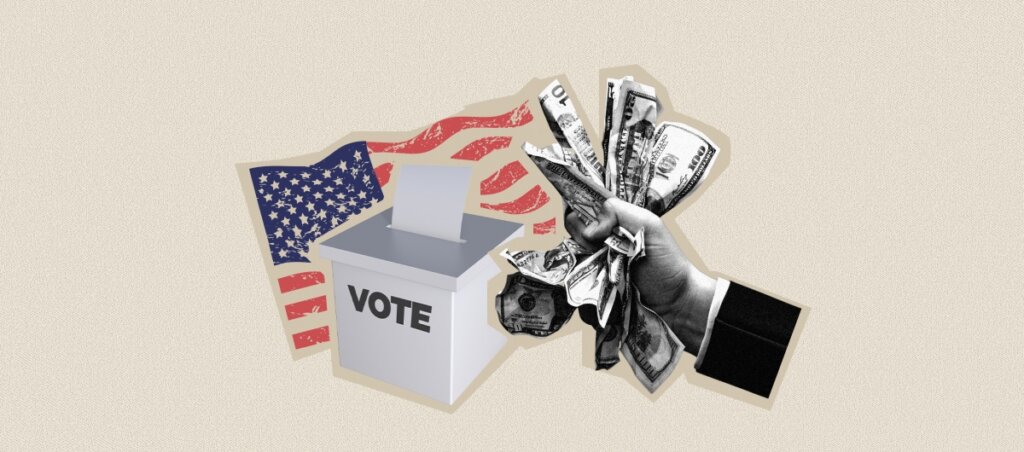
The Supreme Court’s 2010 decision helped create a new era of corporate and billionaire spending in elections. Here’s how that system took shape — and where efforts to rein it in are gaining ground.
This article was made possible because of the generous support of DAME members. We urgently need your help to keep publishing. Please join us for as little as $1.00 a month or make a one-time gift in any amount!
Through a series of cases, including the recent Watson v. Republican National Committee, the conservative majority on the Supreme Court has enabled a flood of unregulated dollars into elections. But the landscape that emerged after Citizens United v. Federal Elections Commission (2010), in which the Supreme Court lifted restrictions on campaign spending by outside groups, laid the groundwork for unchecked corporate spending seen today. Written by former Supreme Court Justice Anthony Kennedy, the Citizens United decision gave way to the age of super PACs and a complex web of other “intermediary organizations” that don’t disclose their donors. As outlined in a Brennan Center explainer, Citizens United set off a chain reaction of events and decisions that led to “a fusion of private wealth and political power unseen since the late 19th century.”
Speaking a year after the 2008 economic crash and a year before Citizens United was decided, professor Richard White explored how railroad baron Tom Scott attempted to influence the 1876 presidential election to expand his railroad empire. As White notes, Scott’s actions laid the foundation for modern corporate interference in American politics. He said men like Scott made Congress a “site of business competition.”
“We cannot fully understand our system of governance or the economic world we have created without understanding how corporations have commandeered the political process in order to compete with each other,” White said during the 2009 presentation.
Now, a mix of Supreme Court decisions, coupled with Trump’s fire sale of the federal government, has ushered in an explosion of money, corruption, and fraud at the highest levels. In a report released last fall, the Roosevelt Institute examined 15 years of Citizens United and how the decision accelerated the decline of American democracy. Without limitations on “independent expenditures,” billionaire spending in elections has skyrocketed since 2010, from $231 million in 2012 to $2.6 billion in 2024. It’s estimated that over 80 percent of the money billionaires spent “during the 2024 election cycle went through channels that were prohibited before Citizens United.” The decision gave way to the age of Super PACs and a complex web of other “intermediary organizations” that don’t disclose their donors.
In a May interview with Firing Line on PBS, Kennedy acknowledged the current landscape was foreseeable. “It was not clear to me that these consequences would not occur,” he said. “They were unintended in the fact that we didn’t want them to happen, but they were predictable, and this caused a problem. But we just couldn’t find a place to draw the line.”
Despite witnessing the gross inequality and billionaire power grab over the last 16 years, Kennedy continued to double down on his decision. He claimed that because newspapers were also corporations and enjoyed free speech protections, other corporate entities should too. While that logic might make sense to a casual observer, it has given way to a small group of wealthy individuals having outsized influence in elections and political outcomes.
Crypto interests exploit loopholes for outsized influence in governance
Less than two years into the second Trump administration, we are witnessing an era of unprecedented systemic corruption at multiple levels of government and industry. The self-proclaimed “crypto” president has leveraged the full faith and credit of the U.S. government to expand the industry. In his first year as president, Trump made over $2 billion in personal income, some of which came from interests he directly influenced through his position. Over half of that came from his crypto ventures and companies that benefited from his massive federal deregulation campaign. Billionaire contributions in the 2024 presidential cycle were about the same as the combined spending from 2012 to 2020. In fact,100 billionaire families doubled their contributions between the 2020 and 2024 elections.
Published by Media Justice, “Crypto Capture: Mapping the 2026 Influence Campaign” walks readers through the goals of the crypto industry’s political spending. Illinois Lt. Gov. Juliana Stratton, a vocal opponent of the crypto industry, was one of the races profiled in “Crypto Capture.” She prevailed in her March primary election for U.S. Senate, despite $10 million in spending by a pro-Trump crypto super PAC.
Media Justice also explored the deep web of influence behind crypto funding in elections in the third installment of its “BroBots vs. the People” political education series. While not the first industry to grease palms in hopes of passing favorable legislation, crypto’s rapid ascension and deep ties in the administration pose a risk to working families and communities across the spectrum.
According to an August report from Public Citizen, corporate spending in 2026 elections has surged past the 2024 presidential cycle. While much focus has been on AIPAC spending, it is mere crumbs compared to investments from crypto, AI and Big Tech, and sports betting—the three account for 40 percent of all corporate spending this cycle.
“The Citizens United decision is, and has always been, a disaster for American democracy,” said Lisa Gilbert, co-president of Public Citizen, in a statement. “Key issues such as affordability and addressing the cost of living crisis have taken a backseat to covert plans to shield crypto from regulation, precisely because of this massive influx of dark money. The fate of elections should be decided by the voters, not profit-driven corporations.”
The Senate’s recent rejection of Trump’s pro-crypto legislation, the Clarity Act, further shows the limits of the current administration’s heavy-handed excess and its business allies. Crypto groups have basically threatened to go after anyone who didn’t go along to get along, making the vote even more important. The vote shows the need for elected officials who will also block bad bills when necessary.
“With this vote, responsible senators defied the septic spill of political spending by the crypto sector and denounced President Trump’s historic crypto corruption,” said Public Citizen economist Bartlett Naylor in a statement. “Trump has netted more than $1.4 billion on his scams, which cost his victims more than $4.7 billion. No Democrats voted for the bill, and Congress should continue to reject these corrupt crypto schemes.”
Protecting the people, not corporations
Getting big money out of politics remains one of the most important fights to turn the aspirational promises of American democracy into sustained reality. One of America’s original sins, money in politics, has shaped who holds power and how it impacts our lives.
For Bentley Hudgins, the former Georgia state director for the Human Rights Campaign, the current landscape is a “natural progression” of what happens when deep inequality remains unsolved. Hudgins, an organizer at the intersection of racial, gender, economic justice and democracy, stressed the need to see money in politics and corporate influence within the broader context of inequality. They contend real democracy will remain out of reach until the imbalance is corrected.
“We have never solved the real problem in America that our economy is based on forced human labor and the extraction of capital from working people through racist capitalism,” they said. “Already the conversation has been warped because working people are in a survival state where they do not even have the luxury of time to consider and think about the world they want to live in.”
Leading reform proposals often include a suite of policies to address campaign finance legislation, public funding for elections, court expansion, and broader anti-corruption measures. Rep. Pramila Jayapal even introduced the “We the People Amendment,” a constitutional amendment clarifying that corporations aren’t people and corporate money isn’t speech. Co-sponsors included Reps. Shontel Brown, Maxwell Frost, Joaquin Castro, and the late Rep. Raul Grijalva.
Billionaires are trying to handpick leaders who will make laws that benefit their unique interests at our collective expense. But legislation that combines proposals offers stronger protection than stand-alone bills. Aimed at expanding voting rights and closing the devastating gap after Shelby County v. Holder, the For the People Act previously introduced in Congress is one example of a comprehensive approach. A broad anti-corruption and voting rights bill, it included provisions to address money in politics, thus connecting anti-corruption reforms to fair political participation. Expanding ballot access and giving people a direct say in how they are governed remains a check on the rising consolidation of corporate power.
“Michigan has a grant and a public matching program for elections that give working-class people a fair shot,” Hudgins said. “Colorado has severe limitations on the amount that people are allowed to spend in elections, both for PACs and candidates.”
Without a stronger regulatory framework, coupled with Citizens United’s protection of corporate speech, the unchecked spending can put some candidates in a tough spot. Hudgins, a well-known Georgia progressive, found themselves in an awkward position this spring when a sports betting Super PAC started spending favorably in their race. A candidate for Georgia HD-90, a solidly Democratic district in metro Atlanta, described the confusion and frustration of an outside group spending in a way that can cause confusion. American Future, one of two groups funded by the Sports Betting Alliance’s super PAC WIN for America, copied Hudgins’ branding and website and spent money in a way that inferred alignment.
“I made a commitment to not accept any corporate PAC money, and I stand by that promise,” Hudgins said. “And the laws as they are, like when independent expenditures enter into the conversation as a candidate, you cannot tell them to stop because if they stop, that’s coordination.”
Hudgins used the moment as a learning opportunity about corporate influence in politics and the millions being spent to divide our communities. The incident also reaffirmed their belief that curtailing corporate influence in politics also requires equitable economic policies.
“How you actually have access to capital is a part of the structure of democracy itself,” they said. “It requires that we fundamentally change how our economy is built, how money encounters elections, which it should not at all. It should be that elections are publicly financed and that voting is universal.”
States have a unique opportunity to rein in corporate influence
Even with the challenges at the federal level, a growing movement at the state level could offer another lane to rein in corporate spending and dark money. Hudgins pointed to recent legislation passed in Hawaii that targets corporate money in elections through the state’s power to regulate corporations. Signed into law in May, Hawaii’s Act 011 cuts through the legal fiction created by Citizens United that treats corporations as people for campaign finance purposes. The first state law of its kind, Act 011 makes clear that political activity isn’t among the powers granted to corporations and other “artificial” entities.
“The foundation of our democracy is that political power belongs to the people,” Sen. Jarrett Keohokalole (District 24 – Kāneʻohe, Kailua), chair of the Hawaii state Senate Commerce and Consumer Protection Committee, said in a statement. “Corporations and other artificial entities exist because the State grants them legal privileges, including limited liability and lucrative tax benefits that individuals cannot claim. Act 011 clarifies that those privileges do not include the power to spend corporate money to influence our elections.”
The Hawaii Senate Majority statement made it clear that corporations cannot bypass Act 011 by donating to PACs. Note: Act 011 doesn’t address PAC spending, which is governed by existing campaign finance law.
As Sonali Kolhatkar previously wrote for Common Dreams in June, Hawaii’s law sidestepped Citizens United, making it irrelevant in that state. Kolhatkar noted 14 states were exploring similar bills. If the state legislature won’t act, citizens could organize and put the issue to a popular vote where ballot initiatives and citizens’ amendments are permitted. Voters in Montana could enact a statute similar to Hawaii through a ballot initiative this fall. An October 2025 poll from Issue One found 74 percent of Montana voters across parties would support such a measure. Issue One found a similar breakdown for voters nationally, with 79 percent of voters agreeing that corporate influence in elections and donations by wealthy donors “give rise to corruption or the appearance of corruption.”
The move follows a brief released by the Center for American Progress titled “Corporate Power Reset,” which argues that states’ power to regulate corporations could limit corporate interference in politics. The brief lays out legal arguments for states to use their regulatory power over corporations to get around the alleged First Amendment issues raised in Citizens United.
Realigning our politics means getting back to the basics
The increased spending and targeted disinformation over the last 10 years have overwhelmed many. By “flooding the zone,” big money can make it difficult for people to know which way is up, leading some to check out of the political process. Having led campaigns at Popular Democracy and the Action Center on Race and Economy, Tracey Corder has mapped political influence and shifts in policy and electoral outcomes. In an interview with DAME Magazine, Corder emphasized the importance of both staying informed and understanding that ultra-wealthy people shouldn’t have an outsized influence in political and social outcomes.
“The other side, and it depends on who you consider to be the other side, is putting their money in, not just like the time leading up to the election,” she said. “Over time they have spent money on certain political projects to shift the landscape in which we operate.”
She said beyond Citizens United, these groups are working “to shift the way our elections work.”
“It’s shifting power away from us, the people, into the hands of very few people,” she said. “It really is about where we have power and, like, where can we throw in to flex our power?”
All of the leading proposals and regulatory fixes cannot move forward without a fundamental shift in how we engage with the political system. Our shared understanding of what’s possible and necessary must also shift. For Corder, part of that means getting back to basics. “People are disenchanted with the government right now,” she said. “The way to get them re-engaged is to have people feel like something is changing because ‘I’m participating.'”
Within Corder’s response lies a simple truth: moving an anti-corruption agenda takes more than policy briefs or legislative proposals. “We the people” excluded the vast majority of people living in America today. But those three words hold a bold mandate for generations to come. It grounds the moral and cultural rebirth needed to move past the current crisis, and makes our collective project redefine and rebuild a multiracial democracy from the ground up. We can’t just hope the institutions will fix themselves. And it definitely means more than telling people to just “Google.”
“The way we turn out voters and the way we win elections long term is to actually deliver for people,” she said. “Nothing is an easier GOTV than being in an area or a community where people know their elected official and feel like that person has delivered for them.”