
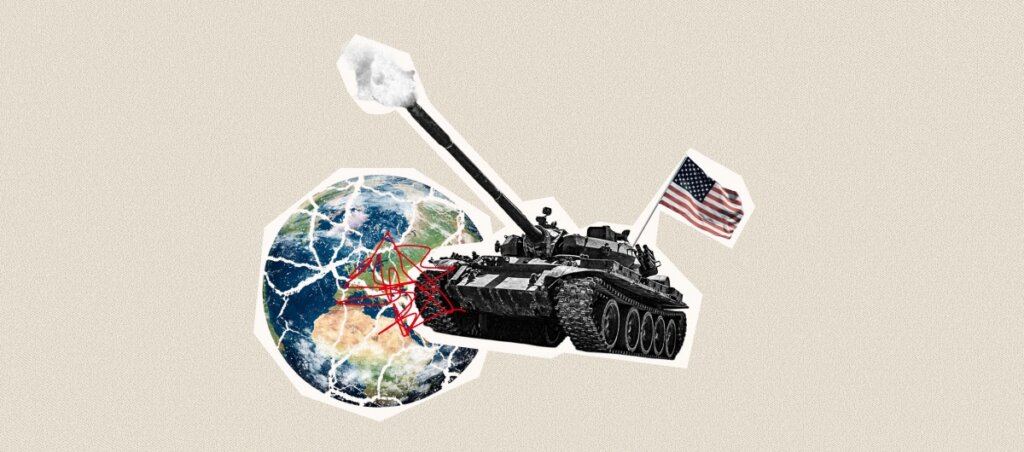
Rising global skepticism and domestic fatigue are converging around a single question: What should U.S. power be wielded for?
This article was made possible because of the generous support of DAME members. We urgently need your help to keep publishing. Please join us for as little as $1.00 a month or make a one-time gift in any amount!
Every day smuggles fresh horrors into our timelines, from war crimes to wage theft to the growing government repression of peace protests.
U.S. extraterritorial claims to Greenland, Canada, and the Panama Canal foreshadow a grim future, but the deeds of US foreign policy consist of a growing list of already actualized nightmares. In the past 24 months, the U.S. has directly attacked or materially supported bombings in Ecuador, Somalia, Haiti, Nigeria, Yemen, Venezuela, Syria, Iran, Iraq, and the Caribbean. A blockade of Cuba—an act of war—continues to ripen the island nation for an invasion in search of a rationale that would square it with the “national interest.” All the while, the Gaza genocide that U.S. foreign policy underwrites hums ominously in the background like so many data centers.
Small wonder that world net approvals of “U.S. leadership” are at a record low (-15 percent) while most Americans (59 percent) reported in April 2026 that “America’s best days have passed.” It all tempts wistful yearnings for the world of yesterday.
But there never was a Pax Americana.
Today’s violence looks less exceptional in light of what the world inherited from the post-Cold War era of American dominance: A legacy of unrepaired harm and poor judgment. Whatever achievements U.S. foreign policy can claim—AIDS medicine to Africa, slowing Russia’s invasion of Ukraine—they are not the seed corn of the present; a history of militarism is. Only by seeing that can we design something better. There is no security in redirecting insecurity toward others.
A Bloody Unipolar Moment
To live through the ’90s meant witnessing the rise of coffee chains and erotic thrillers, grunge and the golden age of hip-hop. It also meant taking for granted something unprecedented: An extreme concentration of global power in the hands of a single nation-state that faced no serious threats abroad.
It was never meant to last. As Ta-Nehisi Coates lamented in The Message, “the privilege of a great power is incuriosity about those who lack it.” The trouble all along was the failure of Washington elites to see at whose expense America’s “unipolar moment” came; a blind spot that ensured its undoing. Middle-class comforts in the metropole masked a darker reality fermenting underneath the veneer of stability at history’s end.
Twenty-five percent of America’s nearly 400 wars occurred during the so-called unipolar moment, since 1991. According to the Brown University Costs of War Project, the Global War on Terror has already cost $8 trillion, 900,000 deaths, and 4.5 million casualties. The Iraq invasion alone caused a million dead Iraqis. America also perfected its weapon of choice—economic sanctions—during this post-Cold War era, the result of which is that the U.S. now sanctions roughly one-third of the world’s governments. The British medical journal The Lancet published research estimating that unilateral economic sanctions produce around 564,000 excess deaths each year, most of them children less than five years old.
Crucially, Americans themselves are not exempt from the tally of human sacrifices made at the altar of American power. Between 2006 and 2020, more than 5,600 U.S. troops have been killed in military exercises alone—that is, training, not actual wars or combat operations. Over 14,000 troops have died in non-combat related circumstances in this same period. More than 140,000 veterans have committed suicide since 2001. And the role of military veterans in the rise of the far right is impossible to ignore: veterans make up at least one in four far-right militiamen. Between 1990 and 2022, a U.S. military background was “the strongest predictor of involvement in a mass casualty plot or attack.”
We do to ourselves far worse than anything Osama bin Laden could have cooked up.
This merely partial accounting of the price of American primacy is enough to puncture glossy misunderstandings about the recent American past; enough to know what to refuse. Reckoning with the errs of American militarism by relating to the world differently is the only way to repair what has been done.
A Progressive Reformation
Restoring America’s global standing presupposes returning sanity to U.S. foreign policy, and that requires repudiating the pursuit of primacy and the impulse to military solutionism that it breeds. As the past generation of American dominance attests, most security problems are made worse—not better—by the application of brute force. And the United States cannot be trusted—indeed, should not trust itself—to discipline and punish its constantly growing list of adversaries.
The world does not need “leadership.” It needs its most powerful nation to comprehend the full costs and benefits of its actions; to see at whose expense its power comes. The world needs a state that can co-exist with—rather than demand tribute from—international society. That adheres to international law, and rejoins the 66 multilateral institutions the United States withdrew from in January 2026. Above all, the world needs a United States that commits itself to a principle of least-harm as it attempts to address the political and economic roots of global insecurity—not just its military symptoms.
But how? What is to be done, and done differently?
Foreign policy needs a progressive, antimilitarist reformation, and not merely because it heals the soul. There’s a strategic logic to doing the right thing. If a Democrat wins the White House but U.S. foreign policy remains militarist in character, changing only on the margins, nobody will think the United States has fundamentally changed. Anyone who continues to see a future Democratic president or Congress as a steward of American empire will not change their calculations and thus a dark global trajectory will persist.
America’s track record undermines the credibility of any good will its politicians might express. The trillion-dollar war machine casts a shadow over even the most sincerely worded aspirations for peace.
Rather than the ends justifying any means, there comes a point at which the means you employ must resemble the ends you seek. Violence is often a dubious way of realizing non-violent ends; domination a foreclosure on egalitarian futures. Fundamentally changing the valence of U.S. statecraft is the key that makes a turn toward peace, cooperation, and justice credible.
Such a transformation should entail thousands of changes across the national security state and its diplomatic apparatus. But that requires more than technocrats; it requires a shift in mindset. The American people and the politicians they elect must come to consciousness about–and reject–the habits of domination that have characterized U.S. foreign policy for far too long. That may take time, but it’s hardly impossible.
The dramatic changes roiling American politics the past several years incubate immense dissatisfaction with American militarism. Candidates in the mold of Zohran Mamdani and Alexandria Ocasio-Cortez are rapidly gaining in popularity, including in red and purple states like Texas (James Talarico) and Michigan (Abdul El-Sayed). Armed with a more critical awareness of our history, this crop of representatives organically links a crisis of affordability, oligarchy, and equal rights at home with views on foreign policy that are antiwar, pro-peace, and consistently anti-imperialist. This new generation of politicians is not going to save the American people; their ascendance is proof that the American people are trying to save themselves.
Pivoting to Peace
There are several priorities that would help sustain a shift toward a less militarized world. They also illustrate what it would look like to realize the kind of change that can credibly claim to be in the interest of most Americans (and the world).
Tame the Imperial Presidency
Relating to the world more peacefully starts with bridling the unchecked power of the U.S. national security state that the president wields. Since the War on Terror began, the foreign-policy powers of the executive branch have become almost unlimited—the very reason the Trump administration can wage wars with seeming impunity and without even declaring them. Congress must reassert its Constitutionally designated war powers by repealing the Authorization to Use Military Force (AUMF) that made the Global War on Terror Possible; restricting the president’s ability to unilaterally order nuclear first-strikes; imposing strict oversight of CIA and Department of War drone operations; and limiting the president’s emergency power, both to deploy U.S. troops on U.S. soil as well as dissolving the Immigration and Customs Enforcement (ICE) agency, which has become a domestic paramilitary force answerable only to the president. Congress should also pass the Stop Militarizing Law Enforcement Act, ending the Pentagon’s “1033” and “1122” programs that have turned community police into counter-insurgent forces.
Slash the Pentagon
When Trump announced the $1.5 trillion military budget in 2026, he acknowledged at whose expense it would come, noting, “It’s not possible for us to take care of daycare, Medicaid, Medicare, all these individual things… We’re fighting wars. We can’t take care of day care.” The simultaneity of the Trump administration’s militarism and U.S. growing inequality is synergy, not coincidence; it is the key wager that sustains American oligarchy. Trump’s admission vivifies the very real tradeoff between guns and butter. What good is political democracy for a people denied a modicum of economic democracy? What good is national security if funding it deprives people of the means to live a secure life? America’s trillion-dollar war machine holds back the dynamic potential of the US economy—the Brown University Costs of War Project found that federal spending on weapons has a lower job multiplier effect than equivalent spending on any other sector. Senator Ed Markey has introduced the Slash the Pentagon Act (S. 4799), which would cap the military budget at $750 billion (half of Trump’s requested $1.5 trillion for 2027). Only seven years ago, $750 billion would have been a record military budget; now, it’s a much-needed 50 percent cut.
A Global Arms Freeze and Peace Dividend
World military spending is out of control, growing for 11 straight years and reaching an all-time high this year ($2.887 trillion). The United States—as the leading militarist by a country mile (accounting for 35 percent of global spending)—has the power to arrest this trend by drawing down its share of the problem and catalyzing an effort to establish a global freeze on advanced conventional weapons production alongside a 2 percent cut to military spending worldwide. Dozens of Nobel Laureates have already signed onto this “Global Peace Dividend” campaign, which could generate more than $2.4 trillion for a UN fund dedicated to combating the world’s grandest challenges—pandemics, climate change, and extreme poverty.
A Green Bargain with China
The world needs a new détente between China and the United States to not only forestall great-power conflict but also to plant the seeds for future economic growth. But the foundation for cooperation will be strongest with a material basis: Meeting the Global South’s urgent need for climate adaptation measures, capital infusions, and debt relief. As part of a larger green bargain, the U.S. should unwind its tariff regime and work with China to marry Western capital with Chinese green tech “overcapacity” (low-cost production for export). As the Global South affordably absorbs renewable energy technologies as a result, climate adaptation in the Global South will not just happen but actually accelerate and happen more cheaply. Many lives would be saved in the process. China might then be much more likely to take losses on some of its sovereign debt holdings if they are offset by U.S. tariff rollbacks. In relative terms, this would be a boon to the American and Chinese worker because if the developing world is in debt default or trapped in the old-energy economy, it will be unable to afford U.S. exports and will remain unappealing destinations for U.S. capital. But a Global South with a climate-proofed economy, free from the yoke of unpayable debt, will be more able to absorb goods, services, and foreign investment. America’s manufacturing renewal could cultivate untapped markets.
Rebalance Power with the Global South
The global economy has historically favored Western powers in a way that has ensured the Global South’s egregious underdevelopment. By some estimates, from 1990-2015 alone, the relationship of unequal exchange between rich countries and the rest amounts to $242 trillion of wealth transfer, enough to wipe out poverty in the Global South 70 times over. If nothing changes, the Global North will reduce the developing world to a space of resource extraction, cheap-labor exploitation, and counter-terrorism operations. This cycle of what Kwame Nkrumah called neocolonialism must end. To do that, the United States should work with China and the G-20 to forgive (not merely restructure) unsustainable levels of sovereign debt; remove all Trump-era tariffs on global South countries; redistribute voting rights at the World Bank and IMF; and increase import quotas for accessing the U.S. market for companies that pay “floor wages” and have established sustainable regimes of resource extraction.
In The Fire Next Time, James Baldwin warned that, “renewal becomes impossible if one supposes things to be constant that are not—safety, for example, or money, or power. One clings then to chimeras, by which one can only be betrayed, and the entire hope—the entire possibility—of freedom disappears.” An empire in decline is prone to irrational spasms of violence. We’re seeing that now. But that’s also a chance for renewal.
The world’s perpetual polycrisis is mostly a product of U.S. foreign policy. Only by seeing that—and stripping American power of its myths—can we design something better. The source code for healing American relations with the world, then, is simple: No peace, no democracy or equality.