
In a moment that echoes Great Depression economic anxiety, today’s Democrats have a blueprint in Roosevelt. Will the party heed history’s lessons on affordability?
This article was made possible because of the generous support of DAME members. We urgently need your help to keep publishing. Please join us for as little as $1.00 a month or make a one-time gift in any amount!
“I don’t have to tell you things are bad. Everybody knows things are bad.” Howard Beale’s line from the 1976 movie Network rings true today, no matter how much President Donald Trump insists that affordability is a hoax. Half of all renters spend more than 30 percent of their income on housing, and 75 percent of homes are out of the price range of a median-income family. Utilities prices are climbing higher and higher. On top of the ordinary precarity of everyday life, there are other looming environmental and political catastrophes. The ongoing war in Iran threatens global energy markets, and higher energy costs could bring on both inflation and a recession at the same time.
Democrats, meanwhile, want to campaign on affordability, but their takes on it have been almost bland. Rep. Katie Porter and Sen. Cory Booker have taken the misguided step of adopting anti-tax positions, campaigning on exemptions for both federal and state income taxes. It’s a page out of the Republican playbook, which of course normalizes it, and it will make it harder to deliver on other Democratic policies. A robust social safety net needs to be well-funded, and that can’t be accomplished solely by soaking billionaires (who should still be heavily taxed).
But even more fundamentally, Democrats have to sell their plan, and that takes more than just announcing it, or even successfully legislating it. One of the commonly-leveled criticisms of the Biden administration was that they didn’t communicate or “sell” their actual infrastructure and climate wins, a fact he has since expressed regret for. The press got plenty of things wrong, but Biden also disliked giving interviews and preferred to be in the background. Obama made the same mistakes in 2009.
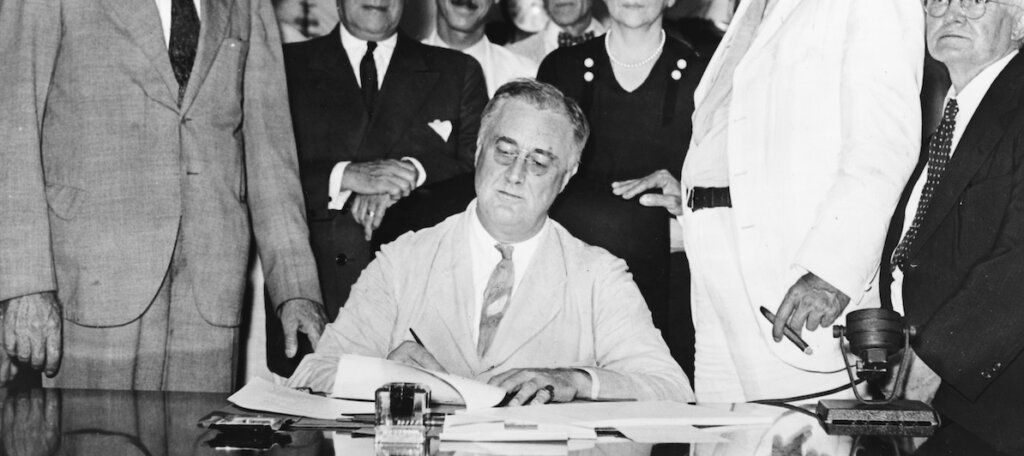
Yet Democrats have a model that they can draw on, one that they love to talk about and nostalgize but can’t seem to imitate: Franklin Delano Roosevelt.
You need to be careful comparing what FDR inherited as president and what Democrats have at the moment. The problems for Roosevelt were staggering. The U.S. economy in 1933 was in the midst of an unprecedented catastrophe: a quarter of the workforce was unemployed, millions more were just barely scraping by, the banking system was on the verge of collapse, foreign trade had basically cratered because of high tariffs (okay, that part is familiar), and farmers were facing ecological disaster from the Dust Bowl.
It might be too much to say that we’re on the verge of another Great Depression, but that ignores an important point: the Great Depression in the United States didn’t have to be as bad as it was. Great Britain largely emerged unscathed from the economic crash, as did France. A slow federal response under Herbert Hoover, particularly once the banking system began to collapse in 1931, made it into a true depression. Today, we’re facing a number of potential economic threats, much like we were in 1929, and Democrats need to plan accordingly. As for Republicans, they’ve made it very clear that they’re happy burning everything to the ground.
So, what can we learn from FDR? First and foremost, Democrats need to relentlessly sell their accomplishments. FDR was constantly finding ways to boost the New Deal, most famously through “fireside chats” given over the radio (still a novel technology in 1933). Those however were just one component. Roosevelt knew how to carefully manage the press: he gave regular interviews, made sure that his various relief agencies had people to manage the press as well, and was (by Biden’s standards) shameless about taking credit for his wins. Democrats today have a strikingly passive attitude toward the press, and mainstream media frequently repay them with both-sides treatment that normalizes Trump and his loyalists. While the media ecosystem has changed dramatically, Democrats can still find ways to reach out to voters, rather than waiting for them to come to them.
Secondly, Democrats need to find ways to quickly deliver on their legislative accomplishments. Things happened quickly during the New Deal, and it imbued that time with a sense of dynamism and the feeling that the government was actively working for people. By contrast, the 2021 infrastructure law was supposed to offer billions for rural broadband. But by the end of 2024, not a dime had been spent: the money had been tied up in lengthy application processes. That left Democrats with nothing to campaign on with rural voters, despite spending years talking about the need for rural broadband.
This does not mean jettisoning planning (the Ezra Klein “abundance” approach) or trying to unleash the private-sector on housing, energy, and healthcare. That’s gotten us nowhere. This leads me to a third point: trusting the government to do things well. One of the New Deal’s greatest successes was rural electrification. In the early 1930s, only one in 10 farms had electricity; by 1950, it was the opposite, and continuing to shrink. What made it possible? The Rural Electrification Administration, which empowered communities to form cooperatives that would manage transmission. Those in government need to trust that government can do things well: if they do that, they might discover that everybody else’s faith in government will go up.
Fourth, Dems must be willing to break with party orthodoxy even when it makes people uncomfortable. Roosevelt was not a great economic thinker, and contrary to popular belief, he was no Keynesian: he came from a tradition of politicians who believed that balanced budgets were a good thing. J. Keynes walked away from a meeting with Roosevelt wishing that he was “more literate, economically speaking.” But he was also willing to jettison that if need be. In a speech before he became president, Roosevelt said this: “The country needs and, unless I mistake its temper, the country demands bold, persistent experimentation. It is common sense to take a method and try it: if it fails, admit it frankly and try another. But above all, try something.” Roosevelt threw a hodgepodge of different strategies at restarting the economy: jobs programs, direct cash payments, the creation of Social Security, financial regulation, and infrastructure. There was a Federal Theater Project for unemployed actors, and a Federal Writers Project for unemployed writers (what I wouldn’t give for one of these).
Finally: rein in finance and the banking sector. The United States was repeatedly struck by devastating financial panics and banking collapses in the 19th and early 20th centuries. One of Roosevelt’s signature accomplishments was the Glass-Steagall Act, which brought an end to these panics. Glass-Steagall was repealed in 1999 as part of a broader trend of deregulating finance. There was a lively debate after 2009 as to whether its repeal caused the Great Recession, but that in some ways misses the point: we need a new Glass-Steagall. We needed one then to govern housing, and we need an even newer version to cover crypto finance.
It’s not that FDR made no mistakes—far from it. The National Recovery Administration (NRA) was supposed to be the centerpiece of how to manage the economy in his first term; it was modeled off of government agencies that managed the economy during World War I, mediating between labor and big business while creating rules for every type of industry to follow. It wound up being a boondoggle because of the sheer amount of regulation and paperwork it created for each and every business; famously, a tailor wound up being fined for pressing somebody’s suit for 35 cents when the going rate was supposed to be 40 cents. Its mandatory codes were overturned in Schechter Poultry Corp v. United States. Today, if you’re looking for a remnant of the NRA it’s the Philadelphia Eagles, who adopted the NRA’s eagle as their mascot in 1933.
But for any and all mistakes, Roosevelt and those under him continued to throw as many solutions as they possibly could, and voters generally rewarded him for it. The Democrats won the midterms in 1934, which is usually when voters punish an incumbent party, and then again in 1936. By this time, they had a three-quarters majority in Congress.
Trump is doing pretty much everything he can to hand Democrats a favorable political environment in 2026 and in 2028. But the aftermath of those elections will be theirs to squander if they spend it nibbling at the margins of affordability. It’s time to take a big, meaningful bite.