
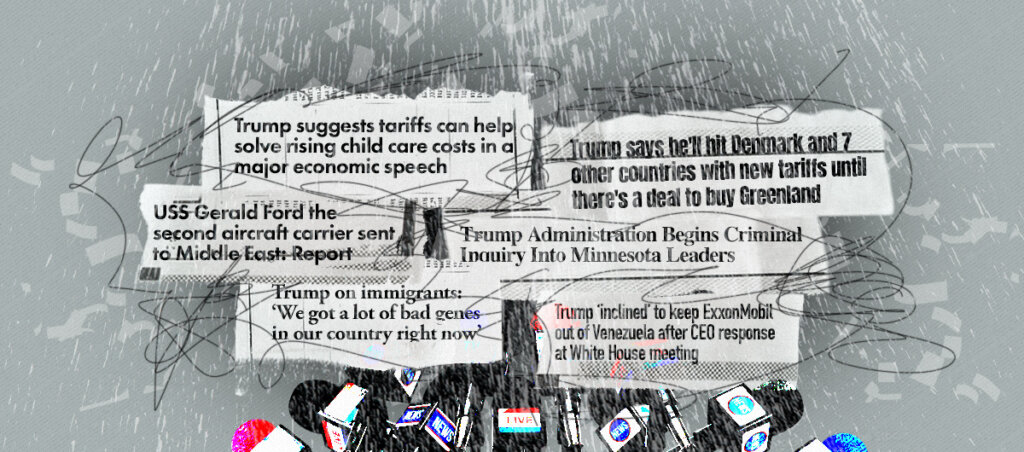
As crises and news events pile up, the connection between them becomes the story the American media machine is least equipped to cover.
This article was made possible because of the generous support of DAME members. We urgently need your help to keep publishing. Please join us for as little as $1.00 a month or make a one-time gift in any amount!
Pick a week. Any week. Take January 11-18, 2026.
Four days earlier, on January 7, an ICE agent shot and killed Renee Good in Minneapolis. By the week of the 11th, protests had spread nationwide, federal agents were deploying tear gas in residential neighborhoods, and a federal judge had ordered ICE to stop arresting peaceful protesters. The administration’s response was not to investigate the shooting, but to open a DOJ investigation into Gov. Tim Walz and Mayor Jacob Frey for obstruction. Trump floated invoking the Insurrection Act. The Pentagon ordered 1,500 soldiers to prepare for deployment to Minnesota.
That was one story.
The same week, the U.S. Navy was moving a carrier strike group toward the Persian Gulf as anti-government protests spiraled in Iran. Trump called Khamenei “a sick man” and said it was time to look for new leadership. Iran’s president responded that any aggression would be “tantamount to an all-out war.”
That was another story.
Also that week, Trump threatened tariffs on eight NATO allies who’d sent troops to Greenland in solidarity with Denmark. EU ambassadors scheduled an emergency meeting. The eight countries warned of a “dangerous downward spiral.”
That was a third story.
And in the background: The ongoing military occupation of Venezuela, where Trump was pressuring Exxon to participate in his oil industry overhaul. Negotiations over a looming government shutdown. Trump renaming the road to Mar-a-Lago after himself.
In a normal week, any one of those stories would have dominated the news cycle for days, with the kind of follow-up reporting that connects the what to the why. But they didn’t land in a normal week. They landed in the same one.
Foreign Policy’s Situation Report was one of the few outlets that tried to hold the full picture at once, noting that Trump had “repeatedly exhibited a willingness to use the military anywhere and everywhere” but had “hamstrung himself” by doing it all simultaneously. Most coverage didn’t attempt that. CNN’s January 16 live blog listed the day’s developments as bullet points: “DOJ investigation… Curbs on ICE… Tensions over Greenland.” Three separate stories. Three separate posts. Each one accurate. None of them connected to each other.
The format did what the format does. The tools of American journalism—the headline, the push alert, the live blog update, the nightly broadcast segment—are built to tell you what happened today. They are very bad at telling you what’s happening, the longer story that each day’s news belongs to. And the gap between “what happened” and “what’s happening” is where this administration operates. They’ve been counting on it.
Editors at major outlets will tell you as much. The AP’s Anna Johnson told The Wrap in December that the challenge is prioritizing what’s most important from “the huge buffet of options that we have to cover on every given day.” The Atlantic’s Adrienne LaFrance, in the same piece, said the 168-year-old magazine is “in a moment-to-moment fight for attention, not just with other newsrooms, but Spotify and TikTok.”
The newest development wins the homepage. The most dramatic quote gets the push alert. When five things happen at once, they compete for the lead. They don’t get woven into a single story about what’s actually going on, because the format doesn’t work that way. Synthesis takes time, and time is the one thing the business model doesn’t pay for.
The people running the strategy know all of this.
In a 2019 interview with PBS Frontline, Steve Bannon laid it out: “The opposition party is the media. And the media can only, because they’re dumb and they’re lazy, they can only focus on one thing at a time.” His solution: “All we have to do is flood the zone. Every day we hit them with three things. They’ll bite on one, and we’ll get all of our stuff done. Bang, bang, bang. These guys will never be able to recover. But we’ve got to start with muzzle velocity.”
Six years later, Bannon sat down with Frontline again. The strategy, he explained, had worked even better the second time around. The DOGE spectacle was useful precisely because it sucked up all the oxygen. “Elon Musk, whether you like him or hate him or think he’s doing a good job, strategically, he was perfect for what he did as far as media narrative because it all centered on Elon Musk and the DOGE effort while so much other stuff was going on,” Bannon said.
That’s a confession. Twice, years apart, on camera. He’s talking about the same machine Johnson and LaFrance are trying to work inside of. One side runs it. The other side figured out how to break it.
Even when journalists have time, even when they sit with a quote or a speech or a policy announcement long enough to write a considered piece, something else goes wrong. The conventions of the craft distort what comes out.
In September 2024, Trump appeared at the Economic Club of New York and was asked what specific legislation he’d pursue to make childcare more affordable. His answer, in full, was a two-minute string of sentence fragments about tariffs, Marco Rubio, Ivanka, and “the kind of numbers I’m talking about.” He did not name a policy. He did not mention children. He said, “Childcare is childcare, it’s something you have to have it, in this country you have to have it,” and then talked about taxing foreign nations.
The AP headline: “Trump suggests tariffs can help solve rising childcare costs in major economic speech.”
The headline bore no resemblance to the answer. But the convention of political journalism is to find the policy in the mess, to extract what a candidate “is saying” from what they actually said. So the AP found a signal that wasn’t there. They imposed coherence on incoherence, because that’s what the job requires.
A month later, Trump told conservative radio host Hugh Hewitt that immigrants who commit murder have “bad genes” and that “we got a lot of bad genes in our country right now.” Multiple commentators noted the remark echoed eugenics. The New York Times headlined its story: “In remarks about migrants, Donald Trump invoked his long-held fascination with genes and genetics.” Former Times reporter Andrew Revkin called it “headline lunacy.” Former Chicago Tribune editor Mark Jacob said the paper had repackaged racism as intellectual curiosity.
There’s a word for this pattern. During the 2024 campaign, it became known as “sanewashing”: the process by which journalistic conventions (the neutral headline, the “critics say” attribution, the instinct to describe rather than characterize) take statements that are incoherent, threatening, or rooted in bigotry and render them as normal political discourse. Nobody’s coordinating this. It’s a set of professional habits designed for a political environment where officials operate in roughly good faith. Applied to a bad-faith actor, those same habits actively obscure what’s being said.
Pay attention to the words that show up in coverage of this administration. “Chaos.” “Unprecedented.” “Erratic.” They appear in headlines, ledes, chyrons, and cable news panels so often they’ve become ambient. And every one of them describes the wrong thing.
“Chaos” implies disorder. Things happening at random. Nobody is steering. But when Russ Vought, Trump’s director of the Office of Management and Budget and a key architect of Project 2025, said in private speeches that he wanted federal workers to be “traumatically affected,” that he wanted them to “not want to go to work because they are increasingly viewed as the villains,” that wasn’t chaos. That was a plan. It was recorded in 2023 and 2024. He described it in detail before he had the power to do it. Then he got the power and did it.
“Unprecedented” means without precedent. No framework, no prior version, nothing to compare it to. But CNN found that more than two-thirds of Trump’s first-week executive orders tracked with proposals in Project 2025’s 922-page blueprint. Bannon, in his 2025 Frontline interview, described years of preparation: major public intellectuals who “bought into the idea that if we were coming back, we had to actually have a policy prescription.” A network of conservative policy organizations, led by the Heritage Foundation, had been building the blueprint since 2022. The precedent is the document. The precedent is the first term. There’s an argument to be made that calling it “unprecedented” erases both.
A president who simultaneously deploys force on four fronts while executing orders drafted years in advance isn’t acting on impulse. But “erratic” is the word that keeps showing up, implying irrationality, a leader lurching from one thing to the next with no throughline. It’s methodical. It just doesn’t look methodical if you’re covering each action as an isolated event.
The language provides cover. If it’s chaos, nobody designed it. If it’s unprecedented, nobody planned for it. If it’s erratic, there’s no strategy to expose. Every one of these words takes an intentional project and turns it into a weather event, something that happened to the country rather than something being done to it.
The speed, the conventions, the language—all of it produces a predictable response in the people trying to follow along. They stop paying attention.
A Pew Research Center survey from December 2025 found that 52 percent of Americans say they’re worn out by the amount of news there is. A separate Pew study from August 2025 found that only 36 percent of Americans follow the news all or most of the time, down from 51 percent in 2016. Among adults under 30, that number is 15 percent.
It’s not that the people those numbers describe are apathetic. They’re overwhelmed. When every day brings a dozen stories framed as urgent, disconnected from each other, stripped of the context that would make them add up to something, the reasonable move is to stop trying to keep up. Nearly half of Americans told Pew they can stay informed even when they don’t actively follow the news. That’s surrender, even if it doesn’t feel like it.
And this is where the media’s built-in weakness meets the administration’s strategy. The administration’s own people have described a strategy that depends on the public’s inability to track what’s happening. Fatigue is the point. When people tune out, the administration operates with less scrutiny.
Eighty percent of Americans told Pew they believe citizens have a responsibility to be informed when they vote. But the infrastructure that’s supposed to make that possible is buckling under its own weight. People know they should be paying attention. They also know that paying attention, the way things work now, isn’t working.
Go back to January 11-18. The fallout from a woman shot on a residential street by a federal agent. A DOJ investigation opened not into the shooting but into the officials who objected to it. Troops preparing for deployment to an American city. A carrier strike group moving toward Iran. Tariff threats against NATO allies. An ongoing military occupation in Venezuela. All in seven days.
Every one of those events got covered. The reporting was accurate. What was missing was the connection between them, and that connection is the story. The tools for that kind of work exist. Investigative reporting traces executive orders back to the think tank documents they were copied from. Reporters quote the architects of a strategy describing it in their own words. None of that is exotic. It just takes longer than the news cycle allows. When it shows up, it tends to arrive after the fact, in the kinds of publications willing to spend the time.
This administration understood that before taking office. They published the playbook. They described the strategy on camera. And the machine that was supposed to make sense of it for the public did what it was built to do. It reported each piece. It missed the picture.
Nobody has a clean answer for how to fix this, and anyone offering one should be viewed with suspicion. But the first step is obvious enough: naming the problem honestly. The story isn’t too big. The tools are too small.