
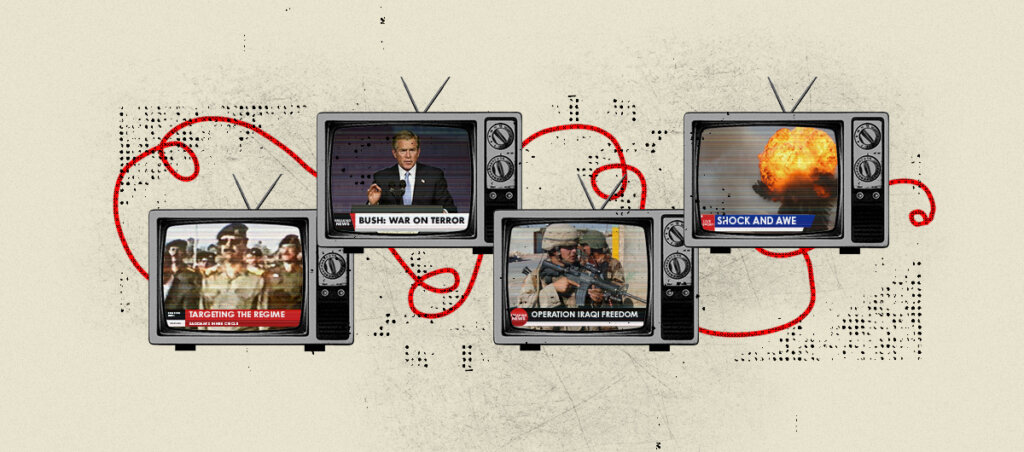
News coverage was quick to normalize Trump's unilateral declaration of war on Venezuela earlier this month, reminiscent of the time President George W. Bush sent troops to Iraq after 9/11. Will media ever stop glorifying war and hold our presidents accountable?
This article was made possible because of the generous support of DAME members. We urgently need your help to keep publishing. Please join us for as little as $1.00 a month or make a one-time gift in any amount!
Two weeks ago, President Donald Trump announced to the world that America had unilaterally attacked the country of Venezuela, abducted its president, and would now be ruling that South American nation.
“We’re going to run the country until such time as we can do a safe, proper, and judicious transition,” he said, touting the capture of Nicolás Maduro, an authoritarian who Trump, without a moment of self-awareness, called “an illegitimate dictator.”
As his staffers looked on, Trump rambled about Venezuelan oil reserves, saying he’d empowered American oil companies to enter the country and take over oil production there. He accused Venezuela of “stealing” oil that “rightly” belonged to the U.S., and rambled that “American dominance in the Western hemisphere will never be questioned again.”
And instead of depicting the news as the ultimate straw in a haystack of erratic, ill-conceived foreign policy moves, instead of gravely warning the American public that its leader had turned the United States into a rogue nation, instead of pointing out that the American president was terrifyingly off the handle, the American corporate press reacted as if FDR rose from his grave and declared victory in World War II.
CNN aired a minute-by-minute breakdown of the “dramatic” raid and aired footage of Venezuelans in the U.S. celebrating Maduro’s capture. Bloomberg’s radio host, interviewing a Yale lecturer, questioned whether Trump now wielded “a Rooseveltian big stick” in the region. NBC News dutifully transcribed the “pro-colonialism” talking points of Trump advisor Stephen Miller, quoting social media posts by white supremacists in support:
And MAGA influencer Matt Walsh, without using the terms “colonialism” or “imperialism,” argued that the U.S. should seize power in foreign countries to extract natural resources.
“First of all, the ‘war’ lasted like 90 minutes,” he wrote in a post to his 4 million X followers. “Second, going to war to secure vital resources for your own people is totally legitimate. Why should we allow some third world communist s—hole to control trillions of dollars worth of oil?”
Quotes from people like Walsh, whose feed consists of fact-free racist screeds about “black crime,” were presented alongside scholars of colonialism from the University of Arizona, as though shitposters’ thoughts were equal to those of academics who’d studied the subject for decades.
By far the most obsequious coverage came from CBS News, run by conservative Bari Weiss and owned by billionaire Trump donor Larry Ellison and his son David. Anchor Tony Dokoupil, in one of his first broadcasts with the network, aired a flattering segment on Secretary of State Marco Rubio.
Dokoupil ended the nightly news by giving a shoutout to Rubio, who he said was “having a moment” during the Venezuelan crisis. Rubio had spent hours trying to clarify Trump’s statements about the U.S.’s role in the aftermath, saying the U.S. would not run Venezuela, but would have some undetermined tasks, and, at one point, belligerently declaring “this is our hemisphere.”
Instead of pointing out the inherent chaos of having a Secretary of State attempt to define what he’d be doing in a country the president had invaded the previous evening, Dokoupil aired a bunch of Rubio memes, including a photo of Rubio as the new governor of Minnesota and “highest of high honors of all — the new Michelin Man.”
“These memes may not add up to much, but to Rubio’s hometown fans, which are many here in Miami, it is a sign of how Florida — once a political punchline — has become a leader on the world stage,” Dokoupil said with a grin. “Marco Rubio, we salute you. You’re the ultimate Florida man.”
As he joked about this, the news broke that more than 80 people were killed in the raid, and seven U.S. servicemembers were injured.
Downplaying criticism of the administration, airing puff pieces on the architects of war, and making a joke out of non-American deaths are all horrifyingly familiar practices to anyone who’s followed coverage of 21st-century military operations. American aggression is always covered favorably, with anti-war voices sidelined to a token paragraph near the end of a story or segment.
While individual reporters may provide valuable insight and crucial fact-checking, the overall tone of the narrative is that any military action must be cheered full-throatedly, lest Americans’ patriotism waver. This is especially true of acts undertaken by Republican presidents.
In 2001, in the aftermath of the 9/11 attacks, American media gave short shrift to anti-war voices, instead encouraging the public to “think about torture”:
Writing in Newsweek, Jonathan Alter asked people to consider making the surviving 9/11 plotters confess their crimes. “Couldn’t we at least subject them to psychological torture, like tapes of dying rabbits or high-decibel rap? (The military has done that in Panama and elsewhere.) How about truth serum, administered with a mandatory IV? Or deportation to Saudi Arabia, land of beheadings? (As the frustrated FBI has been threatening.)”
As America did just that — locking up what the George W. Bush administration called “enemy combatants” without charges or trials, sending the accused to countries known for torture — the three major broadcast networks focused their coverage on how America would retaliate. ABC News tagged its coverage “America Fights Back”; NBC initially dubbed theirs “Attack on America” and later “America on Alert”; and CBS used “America Rising,” “America Fights Back,” “Terror Trail,” and finally “America Strikes Back.”
NBC, the most restrained, called its coverage “America on Alert.”
As the United States attacked Afghanistan and then Iraq under the guise of rooting out terrorism, reporters “embedded” with U.S. troops produced breathless segments about mundane things like troops “discovering” old, unusable weapons, under chyrons of waving American flags.
The puff pieces were just as outrageous as Dokoupil’s Rubio profile. MSNBC’s Chris Matthews gushed over George W. Bush’s 2003 declaration of victory in Iraq, saying “He won the war.” Newsweek called Bush “America’s dragon slayer.”
Good Morning America invited a supermodel to tell its audience that Defense Secretary Donald Rumsfeld was hot.
“I love him,” she told anchor Diane Sawyer. “He’s just — he’s really, obviously really strong.”
On the Today show, Katie Couric gushed during an interview with a Navy commander and said, “I just want you to know — I think Navy SEALs rock!” People magazine named Rumsfeld as one of their “sexist men alive” as Rumsfeld was lying to the American public about Iraq having weapons of mass destruction.
This kind of approving deference is rarely granted modern Democratic presidents. When Barack Obama intervened in a 2011 uprising in Libya, media outlets were quick to platform “bipartisan criticism” and question his actions. Joe Biden oversaw a withdrawal from Afghanistan planned before his presidency; he was attacked by “objective” reporters like CNN’s Jake Tapper for abandoning the country.
But even grading on this curve, giving the Trump administration the benefit of the doubt over invading South America is a new low for the American media.
Both the attacks on Venezuela and the war in Iraq were about oil, about securing resources America wanted from sovereign nations. The American media knew full well that Iraq bore no responsibility for 9/11 but allowed the Bush administration to lie to the public about connections to terrorism and “weapons of mass destruction.” The Bush clan had four generations of ties to the oil business and a relationship with the bin Ladens and Saudis, but all of that was swept under the rug in favor of fear cloaked in patriotism.
Trump spent months attempting to convince the American public that his attacks on Venezuela were about narco-trafficking. His administration blew up fishing boats and killed more than a hundred people without providing any evidence they were smuggling drugs. But once the U.S. began seizing Venezuela’s oil tankers, Trump more bluntly stated that he wanted that country’s oil and intended to take it.
“Venezuela unilaterally seized and sold American oil, American assets and American platforms, costing us billions and billions of dollars. This constituted one of the largest thefts of American property in the history of our country.”
Shortly after attacking Venezuela, Trump went on to threaten a takeover of Greenland from Denmark, a move that spurred the Washington Post to publish an explainer: “Why Trump Wants Greenland, and What’s Standing in His Way.”
The paper treated Trump’s word-salad sputterings like serious policy proposals worthy of debate, asking lawmakers to offer their own opinions, none of the published ones including, “wait, WHAT?” or “that sounds incoherent and absurd.”
NBC News suggested “Next Stop, Nuuk?” and quoted Trump’s false assertions that Russia and China would seize Greenland if the U.S. did not.
Should Trump actually follow through on his threats, we should not have to sit through another deluge of stories about what a strong wartime president he is. Not if we still haven’t reckoned with the mischaracterizations of what happened in Venezuela, or for that matter, in Baghdad or Kabul.
After a fraudulent war and now a reckless campaign of rogue attacks, Republican presidents should no longer receive the presumption that they have the best interests of the American military, or the American people, at heart. The coverage should not begin with Trump’s lies followed by tepid fact-checking by “some critics.”
We’ve seen this before and we know how it ends.